Sunday, October 19, 2014

Annie Hall

In this film, Woody Allen uses techniques that aren't commonly used. Throughout the film you see memories of Alvy Singer. But many times there is a flashback, you see Alvy standing and talking to the people in the memory like they can actually see and hear him. But he knows they really can't because it's just a memory. Then he will proceed to talk into the camera and explain what is going on.


One scene that really stuck out to me was when Alvy, Annie, and Rob went to the house Alvy grew up in. This scene stuck out the most because Alvy wasn't the only one that could see the actual memory happening. Annie and Rob saw it too. When Alvy was "talking" to his mom, Rob told Alvy he didn't have to say that because she couldn't hear him anyway. At first I thought we were just seeing everything from Alvy's point of view but soon realized everyone saw what he saw. It was like they were inside Alvy's mind. Was this distracting in the film? Or did it add to his character?


Annie Hall

Annie Hall follows a hopeless romantic named Alvy Singer and his adventures of his memories with his girlfriend Annie Hall. This movie is not just comical through the characters dialogue to each other, but the dialogue to the audience. Throughout the entire movie there are multiple times when the actors break the fourth wall in order to address the audience. At one point in the movie Alvy and Annie are in line to see the 1972 French documentary The Sorrow and the Pitty. While they're in line there is a professor who claims he knows everything there is to know about a theorist named Marshall McLuhan. Alvy starts to get very agitated by phrases the man behind him is saying so he addresses the audience in a more formal way speaking directly to us. He's telling us that what the professor behind him is saying are false interpretations of what McLuhan is really trying to say. 
Woody Allen using this technique to break the fourth wall is both comical and inviting. It make the audience feel like Alvy is really talking to us complaining about his life and asking us for our opinions. It breaks away from traditional film making because breaking the fourth wall isn't typically used by directors. Another example of when Alvy breaks the fourth wall is in the very beginning of the movie when he talks directly to the audience giving almost an introduction to what the movie is going to be about. He tries to give two jokes that don't really seem to be that funny, but the fact that he's addressing the audience and talking directly to the viewers creates a funny connection with Alvy. Do you think that the breaking of the fourth wall was used more to create comedy or a connection with Alvy? or both?

Annie Hall

Annie Hall

       The comedy Annie Hall is not only funny because of the characters and dialogue, but for its distinct splicing of the screen. In several scenes throughout the film, the screen is split in two, or there are two conversations occurring at the same time. In the scene where Annie and Alvy first meet each other, there are subtitles at the bottom of the screen where you see what they are thinking, which is very different than the dialogue. This has a comedic effect because it is relatable. Everyone has conversations with themselves in their head that criticizes things they say or do, although we usually never hear them from other people. It makes the characters vulnerable, because we hear their inner thoughts. In another scene, the screen is split in two and we see Annie in her therapist's office and Alvy in his therapist's office. Their therapists are asking similar questions and Annie and Alvy have very different responses. This has a comedic effect because they have very different views on their love life.


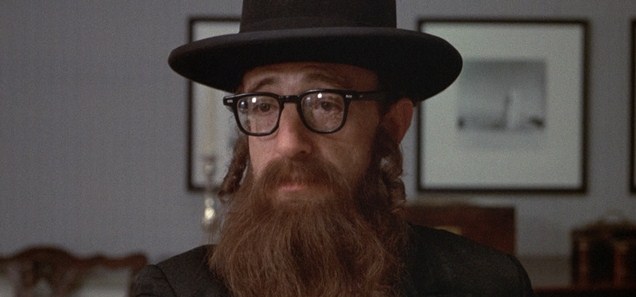
       Another funny element in the movie is the use of stereotypes. Alvy often makes fun of himself for being Jewish, and even dresses as an orthodox jew in one scene. New York City and Los Angeles are also stereotyped to be like characters. NYC is just like Alvye; depressive, death-obsessed, and dark, while LA is more like Annie; carefree and relaxed. What other stereotypes did you notice throughout the film, and why do you think they had a comedic effect?


Annie Hall

In Annie Hall, there were two uses of a split screen. One was during Annie and Alvy's therapy. On the left side, there was Annie. Her room was mostly white, and had many lighter colors. In contrast, on the right was Alvy. His room was mostly brown and dark. Those palettes also make sense for each character. Alvy is a somewhat depressing character. He has a bleak outlook on life, and is depressing. As it was mentioned a few times, he is mainly interested in books about death. Also, he prefers New York to the lifestyle of California. Annie, however, has a much brighter view. She does not like Alvy's constant negativity, and does not share his views. She prefers a life in California, where everything was brightly colored, fast, and loud.
Another thing I found interesting was how they were almost talking to each other. They would both talk about the same things, but each would have an almost opposite view on some things, other times they would say the exact same thing. Annie said she felt guilty because Alvy was paying for therapy, and Alvy was complaining about being the one paying. But, Alvy also said they almost never sleep together, while Annie said it was too much, even though they were both talking about the same amount of time. 

Annie Hall

This film, Annie Hall, differs from any comedy ever seen before. The multiple perspectives and montages throughout the film was something new to watch and interesting. Love, a common theme in films, was a huge, repeated element in Annie Hall. Alvy throughout the film falls in and out of love but in the end only wants Annie.
Alvy's relationship with Annie is what the whole film revolves around. Annie and Alvy benefit each other as Alvy helps Annie be more confident in her career of photography and singing while Annie, smart and intelligent, keeps up with Alvy and his shrewdness. Their relationship unlike the others doesn't revolve around sex and though it's not perfect, they love each other. 

Alvy's first wife, Allison, was the perfect smart, liberal, and jewish. She was always willing to have sex with Alvy but he began to get bored and uninterested. This differs than his other relationships because Allison is a female interested in him and he isn't interested in her in return.
Alvy's second wife, Robin, was a snobby, involved and intellectual person whose main priority was conversing about her academic standing`with other pretentious people. Alvy makes several attempts to make love and be alone with her, but she refuses every time and won't complete sex with him, and blames the city. This is a different love connection as this time, Alvy isn't the one uninterested.
Alvy's one-night-stand, Pam, was an reporter for the Rolling Stones. Alvy isn't as into it as he wanted to be, as it was set up by his friend Rob. In the middle of their sex attempt, Alvy gets a call from Annie Hall and rushes to her apartment, leaving Pam alone in his room.

We see that of all the people Alvy has the opportunity of being with, he finds something wrong with every single one of them. The only one he wants is Annie, which is quite interesting as he never proposes to her... but does that really matter? He kept going back and only wanted her. The concept of love in this film has been repeated and skewed in many ways. Is Alvy capable of being in love? If so, is it possible for him to hold a relationship?

Annie Hall


In the film Annie Hall, the director comments on the key to happiness and successful relationships through Alvie and his relationship with Annie. Alvy is a very opinionated character that is easily bothered by little things and Annie grows tired of his ways. Throughout the movie, Alvy tries to figure out what exactly it was that ended his relationship with Annie; he concludes that relationships are crazy yet necessary. The audience is informed that Alvy was married twice before and both marriages didn't compare to his relationship with Annie. He finds her a bit odd in the beginning but is smitten with her sense of innocence and ability to laugh things off. Annie is a singer who doesn't have much confidence in her act, Alvy pushes her to continue and even explore going back to school to further her education. Although Alvy has good intentions for Annie, eventually she thinks that she was never smart enough for him and was irritated at how much he pushed her. Annie is someone who simply wants to experience all that life has to offer her and make something of herself whereas Alvy is a very hostile person who has conspiracy theories about almost everything. Annie even says to him, "Alvy, you're incapable of enjoying life…you never try anything new." I feel as though this was what eventually drew them apart because the two had very different out-looks on life. In your opinion what was the deciding factor that broke the pair up? How did the director show this? 

Annie Hall

Throughout the film Annie Hall there are a lot of scenes that break the general rules of what we think a movie should be. When we think of a typical movie, we generally imagine characters talking to only other characters and for them to be in one time, whether that be past, present or future. Though, in this film that is not the case. We see Alvy numerous times break the fourth wall and speak to us, the audience. I believe that this technique, was used at appropriate times in order to engage the audience and make it feel like we were not just watching a plain old film, we were experiencing it with him. Another part of the film that made in unorthodox was when they were in the present witnessing the past. When I say this I am talking about when Alvy is in a room explaining what happened in the past. While he is talking about the past, we see them looking at the same room, but with those past events occurring. At first, this technique was very confusing and hard to understand. Though as it went on, it grew on me and allowed myself and other audience members to get a glimpse as to what Alvy saw. Once again, this allowed us to connect more with Alvy and engaged us more into the film.

Annie Hall

Annie Hall is a film that features a past relationship of leading character Alvy and Annie Hall. Throughout the film, the use of "fun" effects are used to display emotions and further detail on what is happening. I found that breaking the fourth wall actually made the film more engaging and relatable. Throughout the film, we see Alvy's physical emotion and internal emotion completely different. When Alvy is at the dinner table with Annie's family, we see him break to the camera and tell how weird he thinks her parents are. Another use of the fun effects are when Alvy and Annie are on their first mini date at Annies house. Alvy is asking her many questions about the art in her apartment, but on the bottom of the screen, we see written, "I wonder what she looks like naked", and the same goes for Annie, as she questions what she says multiple times and wonders if she sounds stupid. Another time he cuts to the viewer is when he is in bed with Alison, and she tells him, "you are using conspiracy as an excuse not to have sex with me", and he tells her no, but then cuts to the camera and says, "Well, maybe I was". The use of the fun effects allows the viewer to get a better feel for what the characters are actually feeling. In your opinion, did the breaking of the fourth wall take away from the film or not?


Annie Hall

The type of comedy displayed in Annie Hall is different of that in The Graduate, the other film we have viewed in our comedy unit. In Annie Hall, Alvy Singer's comedy is very direct, as he literally faces the camera when he narrates other people's conversations, and his own life. He is also funny on purpose because as a comedian, he naturally uses humor in any situation. He even tends to find light in his own misfortune, and to attempt to get out of sticky situations. We see this after the meet up with Annie Hall at the cafe in Los Angeles, when he backs into two cars due to his awful driving and frustration, leading to a police officer stopping him. Even though he tries to be funny with the officer, he ends up behind bars. This is probably the only time in the movie when Alvy's humor is not welcome or acknowledged.

In The Graduate, the humor is more natural instead of obvious, which sets it apart from other comedies. For example, Benjamin's reaction to Mrs. Robinson seducing him is hilarious because he is so naive and caught off guard. While he is clearly scared and uncomfortable, you can see that he somewhat enjoys it, and it eventually works, which is both funny and ironic.

Something that Benjamin and Alvy share is their self-consciousness, which adds comedic value to both movies, because what they see in themselves is not as noticeable to the audience. Alvy is insecure about his physical features, such as his body, and his own comedy, as well as his ability to please others. When he does stand-up, he often fears that he is not good or funny enough. Annie Hall shares this self-consciousness because whenever she sings on stage, she fears that she is not talented enough or performs her best. Benjamin also feels that he is unable to please others, which is due to the fact that he has no motivation to do so. The only person who forced him to please her is Mrs. Robinson, and the fact that he was forced into doing something he wasn't comfortable doing shows that he had no control over his life, which is entertaining to the audience.


Is direct or natural humor more appreciated in comedy films?


Annie Hall

Noah Pines
Robbins
Film Analysis
10/20/14

Woody Allen's Unusual Shots

Throughout Annie Hall, we see a variety of different shots that are not used often in other films. Some examples include, speaking directly to the camera (breaking the fourth wall) and a long, stationary shot of a sidewalk, with the audio of Woody Allen having a conversation. During the stationary shot, we do not even see Woody Allen until he turns the corner, and walks past the camera. The length of time the shot takes up, and the combination of the visuals and audio make this scene unique.

Other interesting scene was while Woody Allen and Annie were in bed, a "second version" of Annie appears and leaves the bed, as if it is her subconscious, and her mind is somewhere else (and not in bed with Woody Allen.

Some other honorable mentions include: a flashback of Woody Allen's to his school days, where young kids speak to the camera, explaining where they are currently, a conversation between Annie and Woody Allen where their thoughts are shown in subtitles, and a scene were Woody Allen and Annie appear in one of Annie's flashbacks.

Annie Hall

Annie Hall is a film about a past relationship, that uses multiple flashbacks and humor to portray the story. One of the most interesting parts of this film to me is how Woody Allen would break the fourth wall as well as make the story humorous.


I found the breaking of the fourth wall to be appropriate for this film. This is because Alvy Singer's character is telling a story that has already happened. I thought that this technique is really unique and realistic of how someone would really be telling a story.

For instance, Singer would break character to describe how he wish a situation could have turned out. This is interesting to me because it's as if the movie is happening live, and we are hearing all about Singer's inner thoughts as he continues with how the story happened.


Woody Allen did something similar as he incorporated humor into the film. When there was a funny moment in the film, it made it seem even more realistic because comedy only works if the story seems realistic, but sometimes in the most strange of ways. Take Alvy Singer for example. His personality traits seemed so far fetched, that they became humorous because Woody Allen was so invested in his character. This made the character's portrayal much more real, producing a comedic film.


Was this film intending to create a natural and realistic product?

Annie Hall

Annie Hall is a movie not renowned for its story line as much as it's use of breaking every unspoken rule movies have, and doing it perfectly. The story begins with Alvy breaking the fourth wall,


there is an animated scene,

 and there are several instances of the present-day characters interacting with memories, but not in a way that depicts them as ghosts or in a dream, as is the only way this is done in any other movie. 


The audience isn't ignored like most movies; instead, Woody Allen chose to include them in the story, to make them feel like they really were watching Alvy Singer throughout his life because he constantly addresses them. This could probably explain Alvy's constant paranoia, and even Rob/Max's worry about getting old- they know they are constantly being filmed, that someone is watching their every move. Alvy is worried about everybody's judgement of him, and Rob about how he looks, both stemming from how they appear on camera. How do the other characters in the film acknowledge that they are being filmed, if at all?


Annie Hall

When watching Annie Hall, not many things cinematographically stood out to me, but there was something that I thought was very interesting - the way Woody Allen filmed flashbacks. He didn't film them like they were filmed in Casablanca or Citizen Kane, where they were achieved through dissolve, but instead as if his older self was still in the scene, observing himself in younger years. I thought this filming technique was very innovative an extremely original even for 2014. Also, instead of just observing himself, he also had himself and the other characters with him at the time actually interact with the characters of the past.

For example, when he gets invited for the first time to Annie's house to have dinner with her family, there is a scene in which the screen splits into two halves and Annie's family interacts with Alvy's family. I thought this was incredibly interesting because the two families were not actually in the same room to actually talk, but they still had dialogue.

There are many scenes of this sort: for example when Alvy and Annie go to two separate psychiatrists, the split-screen method was used to show contrasts between the two. For example, Annie's room was completely white and everything in her setting was illuminated by light. We know that her psychiatrist is a woman, because we hear her voice, but we don't know what she looks like. Annie is sitting, wearing business-casual clothing, and talking about her problems. Alvy's room, on the other hand, was dark and gloomy. We actually see his psychiatrist, but he does not speak. This shows to us the complete polar opposites of Alvy's and Annie's crisis, although they are mutually experiencing not only difficulties in their relationship, but as revealed later, the discomfort they feel that they are paying for two very unhelpful psychiatrist sessions.

There are also other tidbits of this similar technique in other parts of the movie: when Alvy is in his childhood classroom as an adult but observes his classmates and himself as small children, and when Alvy witnesses a family gathering in the 1940s with his crazy "nickel" uncle are both examples of this.


Saturday, October 18, 2014

Annie Hall

Scott Yarmoff
Mrs. Robbins
Film Analysis Period 3
10/18/14
Rulebreaker Annie Hall
I have never seen a movie break as many rules as many times as Annie Hall. Alvy would talk to the audience many times which is very unusual for a character in the plot. Multiple characters would be in the same room as people from many years ago, including themselves. Characters from different times and places would interact. Alvy would talk to random people who would openly talk about their lives even in ways that they would never truly say out loud, like saying that they are shallow, and even talking to a cartoon. This film is clearly a comedy, but even so, how did they get away with all of these techniques and not look like a mess of a film? All of these things were clever and well put together instead of being confusing like it very well could have been. That takes some incredible writing and directing.

Annie Hall

In the film Annie Hall, directed by Woody Allen, expresses many unique techniques of character display this isn't commonly used. The most significant use of character expression in the film is when the main protagonist, Alvy Singer, almost pauses the story of the film and talks directly into the camera as if he is speaking to the audience. This happens a few times during the film and when he does this is usually at a time of conflict where he feels the need to explain himself and his perspective. As Alvy does this everything around him is still moving and alive however the audio only focuses on Alvy's voice and the camera is still in wide view however all the other characters aren't directly paying attention to the camera itself therefore only Alvy is focused on. As he does this he has full control over the other characters around him and enables him to see their reactions to the situation and respond to his questions on the issue.
The scene that stood to me the most that used this method of character expression is when Alvy and Annie and waiting in line to see a movie. A man behind them is critiquing anther film which agitated Alvy greatly because he believe this man had no proper knowledge of any film analysis. As this is happening Alvy takes a pause from arguing with Annie about this and begins letting out his frustration as he speaks towards the camera. This became more interesting once the man who was annoying Alvy almost comes to life in this pause of reality to counter argue Alvy. This gets even more interesting once Alvy brings in the director of the film they were talking about just to prove his point and express to the audience his control over the things around him in aspect of demand.
Do you think this technique was distracting from the actual story of the film or added more character analysis?


(http://fairuselab.net/2012/04/27/mcluhan%E2%80%99s-cameo-scene-in-%E2%80%9Cannie-hall%E2%80%9D/)

Friday, October 17, 2014

Annie Hall

One thing that stands out to me in Annie Hall, was the use of "fun" effects that we, as a class, have not seen in any of the films we have watched so far. My favorite was when Alvy would turn to the camera and talk to the viewer. To me, it made me feel as if he was just talking to me and no one else in the room. I think that he did this to create a more intimate feeling among the viewers and the characters. It made it feel as if you were personal friends with Alvy and you were actually talking to him face to face.


Another interesting effect that stood out to me was the use of split screen. Although I have seen split screen in other films and T.V. shows, I thought the one in Annie Hall, was especially unique. When the screen is split between Annie and Alvy and the other characters, I noticed that the screen in unevenly split; it is not half and half, it is three fourths and a fourth, with the majority being focused on Alvy. This was done in order to focus more on Alvy feels, rather than Annie, because after all, Alvy is the protagonist. Also, I think that the splitting of the screen shows just how different they are as people, which is ultimately an insight to why they break up by the end of the film. It is almost used as foreshadowing.


These two effects enhance the witty aspect of not only Alvy, but the film as a whole. What other effects do you think possibly help add to the clever, and humorous nature of Annie Hall? 

Annie Hall

On all fronts, Annie Hall is a brilliant film. The dialogue is genius to the point of frequent hilarity, and the varying techniques used to convey different aspects of Alvy's personality are very well incorporated. I'd like to touch on the film's point of view. Although the film is shot objectively, with us observing the events, there seems to be something slightly off about the characters and settings. This effect is heightened by Woody Allen's writing. In my opinion, this is done to show that everything, although objective, is from Alvy Singer's point of view. Because of his paranoia and seemingly manic depressive nature, everything seems a bit exaggerated and particularly unjust or unfair to Alvy. For example, he always judges people as stereotypes of one kind or another. For example, to Alvy (and the audience), everyone in California seems to be a pretentious, artistic, phony. Annie's family appears to him as something out of a Norman Rockwell painting, as he comments in the film. We can also look at scenes like Alvy's conversation with Duane. Perhaps Duane wasn't really sitting in the corner of his dark room, and perhaps he didn't describe his dark fantasies in such grim detail. Perhaps this is just how Alvy saw it. His paranoia of course, is brought out in the true events of the film, such as his accusations of anti-semitism (one of which is right).
Do you think Woody Allen intended all of this?


Annie Hall

Lauren Hope Gottschalk
Mrs. Robbins
Critical Analysis of Film and Literature
17 October 2014
Annie Hall
Woody Allen used many different and stylistic techniques through the film Annie Hall, yet one was especially outstanding to me that has not been seen in any of the films that have been watched in this class thus far. When Alvy Singer needed advice and seemed confused about his relationship he would begin to talk randomly to people that were walking down the street or in social places. He would ask them questions that would personally pertain to his life and the street walkers would respond like they were friends of Singer's.   
It was not expected that Singer would walk up to someone random and explain his relationship questions. This approach paid off because it made those parts of the movie humorous. 

Wednesday, October 15, 2014

The Graduate

The ending of The Graduate leaves a large amount of room for interpretation. The song, "Mrs. Robinson" is manipulated to give the final scene of Benjamin racing to stop Elaine's wedding a suspenseful feel and a more dramatic mood. 

The original tempo of "Mrs. Robinson" here is manipulated in sync with the diegetic sounds; being both accelerated when Benjamin is driving frantically to Santa Barbara and slowed down when his car runs out of petrol.


The rhythm fades as the car slows down and Benjamin jumps out to run the rest of the way to the church. The contrast between the changed rhythm of "Mrs Robinson" and the noises of the wind and passing cars while Benjamin is running creates even more suspense.

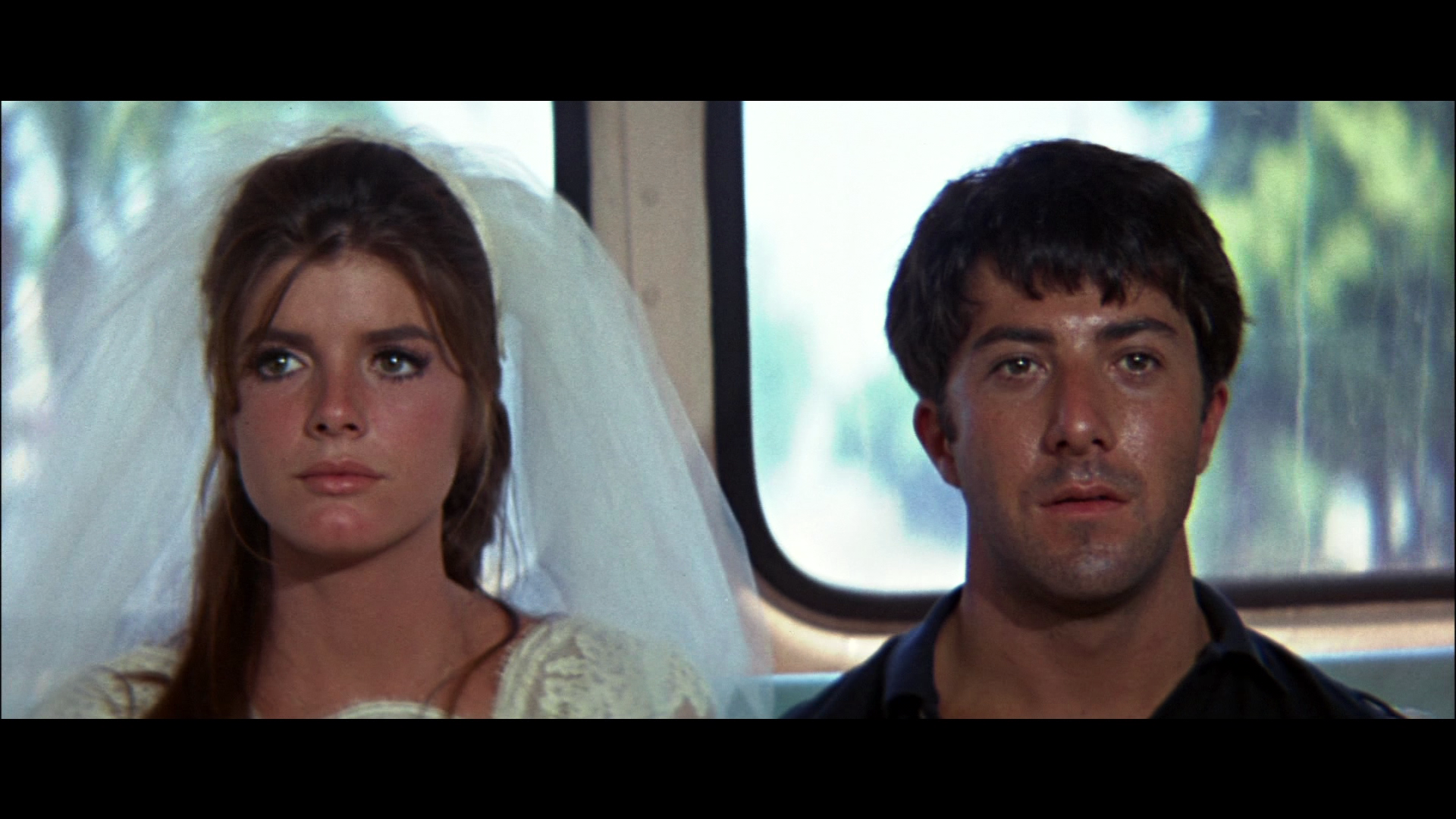
The final shot of The Graduate is of Benjamin and Elaine on a bus. It slowly starts driving away from their previous, planned out lives while their facial expressions turn from happiness to sense of anxiousness.“The Sound of Silence” starts to play; a song, in my opinion, that describes Benjamin’s feeling of dissatisfaction and isolation. I think that through sound and suggestion, The Graduate closes on an confused note, leaving plenty of room for interpretation. How do you believe the movie ended and would you change anything about it? Do you think the music or the images have more of an effect on the movie’s final scene?


Tuesday, October 14, 2014

The Graduate

As we watched the film and discussed its soundtrack by Simon and Garfunkel, the song "The Sound of Silence" stood out to me among the others. The reason for this lies in the first line, "hello darkness, my old friend." We hear it in the first scene of the movie as Benjamin stands on the moving walkway in the airport, completely emotionless. Because he seems so deep in thought during this scene and throughout the movie, I was wondering if he has a history of depression or sadness. He is unsatisfied with his life and unaware of his abilities to succeed in life. He spends a lot of time at home and doesn't have the motivation to do anything, which his parents point out multiple times. An observation I just made is that when he is in the pool or looking at/near water, he is reflecting on his life as he watches the water. This brings me to the next time the song begins to play, which is after he and Mrs. Robinson fornicate in the hotel, the first time. As the song plays, he transitions from the pool/his house back to the hotel scene, as if each door leads him back to the memory of the night before. He must feel guilty for what he has done, which is why the darkness is coming back to him. However, The last time the song is heard is at the very end of the movie, where Benjamin and Elaine have just escaped her wedding and gotten on a bus. They are smiling and exhilarated, and when the song begins, Benjamin is smiling, which is ironic considering the lyrics of the song. To me, this showed that he has overcome the darkness he once felt inside of him. He is finally doing something that makes him happy, which he has never had for his whole life.


Are there any other songs in the movie that are significant/show as much of what Benjamin is feeling as this one?

Monday, October 13, 2014

The Graduate


During the movie The Graduate something that lingered in the back of my mind was what was motivating Mrs. Robinson to seek this relationship with Ben. After re-watching a number of scenes it becomes apparent that Mrs. Robinson is looking for youth.

Youth is a big theme from The Graduate and Mrs. Robinson is a symbol for the future or the longing for youth. In the scene when Mrs.Robinson invites Ben back to her house, and she tries to tempt him which leads to Ben accusing her of seducing him, she takes it as a compliment instead of an insult. This alone how all she wants is somebody younger to want to have feelings for her and make her feel like she is young not old and washed out. In that same scene when Mr. Robinson comes home, he talks about how you can never be twenty-three again. This scene is what shows us that Mr. and Mrs. Robinson both regret decisions they made when they were younger and wish they ventured out and had flings instead of tiring the knot.

An important way to show this longing for youth from Mrs. Robinson is how she is clothed throughout the movie. In almost every scene between her and Ben she is wearing clothes that women who are old mothers and married shouldn't be wearing especially cheetah print. This all tells the audience that Mrs. Robinson has a serious insecurity problem about age and tries to make up for it by wearing flattering clothes.

The whole relationship between Mrs. Robinson and Ben also felt like Mrs. Robinson using Ben as almost vitamin D, keeping her young and healthy. In an odd way she was sucking the life out of him and putting him in a position where she was taking his youth and he was losing it. The director shows this by having Ben do nothing but be with Mrs. Robinson instead of doing what normal twenty something year olds should be doing.

Another way the director showed us Mrs. Robinson was searching for youth was the rack focus in the scene Elaine finds out Ben has been having affair with her mother. I believe the rack focus in this scene shows that Ben has replaced her with something younger and it is the only scene Mrs. Robinson isn't in make up. The camera is focused on young Elaine and when it switches focus to Mrs. Robinson it shows her wrinkled and older than ever shown, hinting to the audience that Mrs. Robinson wasn't getting her youth anymore from Ben.


Provocative Clothing on Mrs. Robinson 
Rack focus showing old and unmake up'ed Mrs. Robinson

The Graduate


The Graduate
Throughout the movie The Graduate by Mike Nichols I picked up on the use of motifs and how they were significant. The first time you see a motif used is when Mrs. Robinson sneaks in on Benjamin while he is in Elaine's room. You see Mrs. Robinson's reflection through the portrait of Elaine which represents how she is trying to act younger than she is. She is trying to act like her daughter would. It also shows how she has to be secretive about what she is doing because what she's doing in proper and shouldn't be done.
Another scene where you see motif being used is in the scene where Mrs. Robinson comes to meet Benjamin at the hotel bar. You see her reflection upside down which represents how upside down this whole affair is. It represents how this is so unusual and just messed up. 
Towards the end of the movie you don't see the use of motifs used anymore because he's in love with Elaine and she doesn't have to prey on him. She doesn't have to act immature in order to win him over.  Mrs. Robinson had to sneak up on him and persuade him into having an affair with her while you always saw Elaine. You always saw her without surprising Benjamin. Do you think that motifs should've been used around Elaine? Do yo 

The Graduate

The Graduate is a story of whirlwind romance, obstacles, and pure coincidence. What are the chances that someone falls in love with the daughter of their secret lover, who also happens to be one of their parents' best friends, and she disappears to go to her wedding?! I'd say slim to none. Well besides the chances, it happens to Benjamin, and it happens fast.

During his affair with Mrs. Robbinson, Ben's curiosity overcomes Mrs. Robbinson's choice to involve no emotions. As her past is uncovered we learn all about the grudge she holds against her own daughter because she is the reason why she has had to endure a dying marriage. Ben is forced to promise her that he will never ask Elaine out, even if its against the wishes of all the other adults in his life.

Besides the promise, Ben is forced into a date with Elaine, which turns into true love.

But do we know that these too sweet-hearts are really in love?

I question this with due reason, based on the last frame in the movie. Once the rush of pulling Elaine out of her wedding, and running away to the nearest bus station, the couple's enthusiastic expressions fade away and more questioning looks begin to overwhelm them.

I believe that this is the reality setting in. They had just made a very bold move, and it was hard to process what was actually going on until it was over. Although I think in some way they do love each other, just like the Robinsons,  the reason why they were both so devoted to each other was not only love, but the thrill of the chase.

The couple was so fixated on getting to the point of relaxation that they never had time to really let their emotions play out. Now that they've run away and embarrassed their family, can they really turn away from each other if their relationship dies?

Will the young couple end up like the Robinsons?