No Country for Old Men was most definitely a suspenseful movie and hard to predict. An element that was prominent was the use of subjective point of view and parallels between different characters. It was used very minimally and subtly, but it was enough to make the viewer feel like they were in the action of the movie. The most effective portrayal of the subjective point of view is when the camera is placed on the dashboard of the car and filming the road.
I think this method of filming is effective in this movie because like the characters driving in the film, you don't really know where they are going or if they are going to find a place to hide or the person they're looking for.
Another way I thought this movie was made more interesting was the parallels between the reflections of Chigurh and Sheriff Bell in the TV in the Moss's trailer. They both sit down on the couch in front of the window, pick up the glass of milk, and there is a shot of both of their reflections in the empty television screen. I thought this showed the idea that they are both looking for Moss, but each for completely different reasons, but it was interesting that they were both shot in the same way as if they were doing the same things for the same reasons? Were there any other parallels between characters that made the movie more interesting?
No Country For Old Men in my opinion was more terrifying to me than Psycho and The Shinning combined. Although The Shinning and Psycho had both psychological fears, No Country For Old Men was violent, gory, and brutal. When Anton kills the people he was sent to kill he's neither sentimental, nor second guessing. He does it without hesitation which in a sense ties in the factor of psychological fears. Anton's use of the captive bolt pistol makes the deaths of the people he kills seem so inhumane and gruesome. What scared me most in this movie was the use of this pistol because of how it was a gun used to kill animals and Anton was using it to kill humans. It made the whole idea of death seem so unnatural and as if he were killing animals. When really all they were, was just humans.
Towards the end of the movie the viewers see Anton start to have what seems to be emotions when he's talking to Llewelyn's wife. He seems to be almost sad that he has to kill her, but at the same time he really doesn't care because it's his job and it's what he does. In my opinion the scene where he tells her that people always say, "you don't have to do this" is what makes me get the impression that he's over this murdering spell. Do you think that Anton has any true emotions? Does he care about killing Llewelyn's wife?
What I found most interesting about this film is how the director created suspense. I'll admit that while watching Psycho and The Shining, I thought that the only way to create suspense was in the way that Hitchcock and Kubrick did it - through music, sounds, and making every scary scene have a normal setting. However, after watching No Country for Old Men, I realized that I also felt anxious due to suspense created in the film, but for a very different reason.
Unlike Kubrick or Hitchock, the director of this film did not use music to create suspense. Instead, what I noticed is that he used clues to give the audience some sort of knowledge about something so that when this object is later reintroduced in the film, the audience would begin to know what is happening and, in turn, become terrified. For example, one of the very first scenes in the film shows the antagonist, Anton Chigurh, killing an innocent man on the side of a road with an air gun (above). By showing this without even introducing Chigurh prior, the director gives the audience some information about a character. Later, we become scared every time we see his weapon or his use of it, such as his shooting of a door knob before entering a room and killing everyone in it. Every time there is even a slight clue of Chigurh's presence, the audience becomes terrified because there is a large chance that he will kill whoever else is in the scene. This is best exemplified in the scene where he has a conversation with the store clerk. Throughout the entire scene, the audience is terrified that Chigurh will possibly kill the man after they finish talking only because of the prior knowledge of Chigurh that the audience has, not because of music, sound effects, or any special camera techniques.
What other techniques do you think the director used to create suspense?
No Country for Old Men was awesome. There are so many moments where the audience is just about to explode with suspense. That is captured through the actors and their amazing performances, and the director.
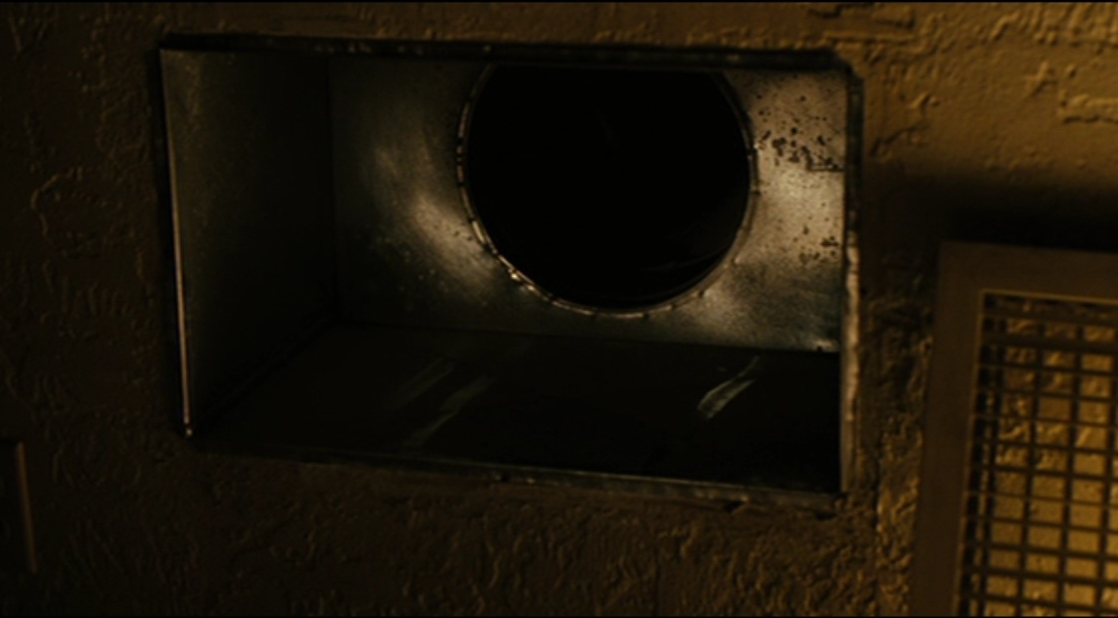
I think this movie has a a lot more deeper meaning than one might think at first. One scene in particular is the one where Tommy Lee Jones's character goes back to the hotel where Luwellin was killed and the lock is clearly blown out by Sugar's oxygen tank. As Tommy Lee walks in, there is a shot of Sugar hiding. After Tommy Lee sits on the bed, the only thing we see in the vent taken off the wall with the screws and a dime, suggesting that Sugar has the money.
The next time we see Tommy Lee Jones is at the very end of the film. I think it is very possible that Sugar killed the sheriff because at the end of the movie it is the first time we see the Sherriff in any other clothes besides his uniform and the room he is in is flooded with light, much like heaven. It also makes sense because there is no reason Sugar wouldn't have jumped out earlier and just killed the sheriff. Sugar also presumably killed Luwellin's wife and they don't show that. The next shot after their scene is just Sugar walking out of the house.
There is no doubt that No Country for Old Men, is a great film. But what makes it so great? There have been plenty movies about a drug deal gone wrong, or the lives of sheriffs in the vast Western states. I think No Country for Old Men takes these two ideals and takes them in a new direction. The drug deal may have gone wrong, but what is interesting is how it sparks a chase between the protagonist and antagonist for the two million dollars. Also, it uncovers a villain that has a unique approach at committing murder, both with his unusual weapon of choice and his sly demeanor.
However, for me the most interesting aspect about the film is the use of subjective point of view. This point of view is used at various times in the film mostly from the driver of a car. I thought what was unique about the way it's used was that it made me feel as if I was sitting on the hood of the car, not in the drivers seat. And sometimes, the camera seems to be angled towards the road, not straight ahead as the driver would see things. But other times it is angled more upwards like in the picture below:
The use of subjective point of view makes the viewer feel as if they are in the action, as if they are Sheriff Bell or Chigurh. I think that this unique perspective that the viewer is forced to take on is what sets this movie apart from others with commonalities. What else do you think helps make this movie different than others with similar themes?
No Country for Old Men is a very violent yet intriguing film. There are many components that are responsible for the film's success in building up such an exhilarating suspense. As the film opens up, there are many long shots of an empty field from a subjective point of view from one of our main characters Anton Chigurh. The viewer is automatically hit with a sense of isolation and better yet, within the first five minutes of the film, a police officer is killed by antagonist, Chigurh. Nearly three minutes later, he kills another person who he finds driving on the street while in desperate need of a new car. As the shot is being filmed, the viewer can see behind the police officer as a long shot and watch the killer plot his murder. Similar to the film Psycho, the viewer can see the killer before the target can. This adds thrill and "excitement" to the viewer leaving them with hope and interest in what will happen next. Another aspect that made the film intriguing was the character development of Moss. Early in the film, we see Moss get asked for water and he seems to be this brave, selfish, and self-oriented person who only cares about himself. However, we see that he does in fact have a conscious because later that night he gets up and brings the guy water even though he was already in bed. In your opinion, were Chigurh's murders symbolic or random? Why?
No Country For Old Men is known as an "almost impossibly faithful adaptation" of the novel by
Cormac McCarthy, all the way down to what could be translated to camera angles. For example, the scene where Chigurh goes to Moss' trailer. In both the book and film, Chigurh blows the lock in with his cattlegun, scans the rooms, takes a carton of milk from the refrigerator, and finally sits down on the couch and "looked at himself in the dead gray screen." (80) This exact shot of Chigurh was used by the Coen brothers, but the most interesting part about it was how they continued to use it. Parallels were a common motif in this film, beginning with both Chigurh and Moss telling their prey to "stand still" before shooting. This shot
created several more parallels between the movies characters in an interesting way too. The first is between Moss and Chigurh again: when Moss arrived home and sits on the couch with Carla Jean, they are filmed in one medium shot. When Chigurh sits on the couch the
next day, he is filmed the same way, creating the parallel between those two men, but the camera also switches to reflect Chigurh in the screen. This seems insignificant until Bell arrives mere hours later, and is shot the same way as Chigurh, in the TV screen. This entire motif is symbolic of the characters relationships to each other: Moss and Chigurh are directly hunting each other, as are Chigurh and Bell,
but Bell and Moss are only involved through Chigurh. What other parallels are made between characters throughout the film?
No Country for Old Men is a great dramatic thriller film. There is so much intensity from Chigurh simply killing people for his own purpose. Anyone that is a problem or a disturbance to his life, he kills with no second thought. However, the people that didn't necessarily cause any discrepancy and are only trying to get by their own lives he considers their lives within a coin toss. There were a few times were Chigurh came accross people that didn't harm him however he still considered killing them. In those times Chigurh would bring out a coin and ask his subject to call heads or tails. He wouldn't explain what they were calling for and just told them to call one side. Each time, the subject would refuse to call unless they knew what they were calling for. You would think Chigurh would just get annoyed and decied to kill them anyways but the fact that he resist killing them in the first place and gives them a chance to survive shows how he didn't have a true intention to kill them.
No Country For Old Men was a great film, scary and violent; there were many things that made it so. The movie opens out with the voice of Tommy Lee Jones, sheriff, discusses a teenage killer who had killed his girlfriend. Here the mood for the whole filmed is laid out for you in a confident voice.
The antagonist really stood out to me, the man is named Anton Chigurh. His appearance is that of a tall man with black hair and a terrifying smile, who travels through Texas carrying a tank of compressed air and killing people.
Chigurh goes to a rundown gas station in the middle of wilderness and begins to play games with the old man (Gene Jones) behind the cash register, who becomes very nervous and preoccupied. It is clear they are talking about whether Chigurh will kill him. Without explaining why, he asks the old man to call the flip of a coin. After seeing him kill the officer at the beginning of the movie, we question as to why he doesn't kill this old man and let's him decide his own faith.
This movie is a prime example of evocation of time, place, character, moral choices, immoral certainties, human nature and fate. Why do you think Chigurh didn't kill this man? What do you think of Chigurh?
Almost immediately in the film, we see Chigurh (Bardem) take his first victim of the film, strangling the oblivious deputy that was watching him. We then see him pull someone over in his stolen cop car, and he uses an air gun to blow their brains out and steal their car. The third time is different though. He stops at a gas station and gets into an argument with the owner of the station. Chigurh bets the man's life on a flip of his coin.
The man guesses correctly and Chigurh leaves. This is the first time we DON'T see Chigurh kill the first person he sees. But why?
I believe that Chigurh only killed out of necessity; he wouldn't kill someone unless he had a reason to. He needed to break out of jail, he needed to steal the man's car, but he had no reason why he should kill the gas station owner (besides getting into a small argument with him). But that doesn't mean he's not crazy. He killed Carson Wells (Harrelson) simply because he felt that he didn't need him. Carson was sent to find the case full of money, which he did, but he was unable to retrieve it. Chigurh told him that he didn't need to know where it was at that moment, because he already knew where it will be later, set at his feet.
He then killed Carson, because he knew he would get it eventually.
In The Shining the scene that stood out to me the most was the scene in which Jack encounters the gold room with hundreds of people in it (even though they really don't exist,) Lloyd the Bartender, and the "red bathroom" scene in which Jack meets Delbert Grady, the supposed previous caretaker of the 1920s who had violently killed his wife and two daughters using an ax.
In the "gold room" scene what I found most fascinating was the immense contrast between what the audience hears and sees and what the audience actually knows. As Jack is walking towards the ballroom, we hear a pleasant swing tune coming from the distance. Instantly, the audience is in a more pleasant mood. When he walks into the ballroom itself, there are many people, all drinking, talking, and having a good time. The setting of the scene tends to relieve the audience from what it has seen so far, but in fact actually makes the audience even more uneasy. The viewers know that the hotel is completely deserted - there is no one there except for Jack and his family. The fact that all the interactions that Jack has with people, the music, Lloyd, the drinks, everything is either paranormal or a figment of Jack's psychopathic imagination. Jack is completely alone, which makes the scene a lot more "creepy." By using pleasant music, a happy scene, and a warm color palette, Kubrick confuses the audience by showing them one thing but really meaning the polar opposite of that.
The bathroom scene immediately following the ballroom scene, where Jack Torrance first encounters Mr. Delbert Grady is perhaps the most interesting scene. In this scene, there is absolutely nothing horrifying that happens, in contrast with the rest of the film. There is no blood, decomposing bodies, dead people, or "shinings" happening. The mere discussion between Jack and Grady is what brings goosebumps to the audience. First of all, the audience knows that Delbert Grady (maybe another name for Charles Grady) was the man who so violently murdered his family years before. The viewers also know that Grady no longer exists, that because Jack is interacting with him he is either a ghost or part of Jack's imagination. What I found most captivating in these six minutes of the film is again the use of contrast that Kubrick uses. The fact that Grady uses such polite and calm language to suggest such horrifying and immoral things to Jack is terrifying. The way that Grady talks to Jack is very reserved - he says "sir" after every sentence he completes, he asks permission to talk about anything that crosses the border between smalltalk and serious discussion, and has impeccable manners. However, when he says that he "corrected" his wife and children is when the audience sees that by the word "correct" he really means "murder." The fact that he uses such proper language to speak about such improper actions makes the audience even more uneasy than before.
How else does Stanley Kubrick achieve fear and anxiety in the two scenes linked above?
Thursday, November 20, 2014
The scene that stands out more than the rest, in terms of fear is when Jack is locked in the walk in pantry. First of all, the first shot shown is Jacks unconscious face being dragged along the floor. The camera is tracking, so his face does not go off center. When Wendy is unable to open the door, Jack is regaining consciousness, she begins to cry because her husband is going insane, and wants to kill her and Danny. The sounds in this scene are in perfect harmony in the sense that you can hear a few different sounds that are going on at the same time, but they come together to instill fear in the viewer. The scariest part of the scene is when he is yelling at Wendy and he is shown from under. The sound while he is trying to reason with her makes you think that she might let him out, but when you see his face you know its a facade.
The Shining is creepy. I have seen it more than once so alot of the moments that the class reacts strongly too, I do not because I know what is going to happen. I think the two things that are key in making the fear in this film are the music/sound effects and Jack Nicholson. The way the music and sounds is qued, it always gets a strong reaction from the audience and makes them jump.
In every film I have seen Nicholson in, he comes off creepy in some way and especially in The Shining...
This shot in particular really highlights the fear that Nicholson can instill into his audience without any dialogue.
Another good example of how music creates fear is when Danny is riding through the halls of the hotel and rides past room 237. each corner he turns the music swells, leading the audience to believe that something bad is going to happen and then nothing happens.
Although we have yet to get to the really scary and suspenseful parts of the movie, the actors and the music have foreshadowed the terror to come beautifully.
So far, Kubrick has gone above and beyond in making the most harmless scenes seem as if there will soon be an enormous surprise around the next corner. This is the quality that makes this film extremely frightening. Kubrick accomplishes this goal by using certain techniques that build suspense in moments of building tension.
One scene in which I see this taking place is when Dick takes Wendy and Danny down to the cellar to see where the hotel stores all of their dry goods. There are two reasons why this scene is scary and they are the music and the camera angle.
The music in this scene is very high pitched as we have heard in past scenes. This sound is screechy and it crescendos over a period of time. This indicates that Danny is "shining", and when we hear Dick's voice talk about ice cream, a question that is repeated in the next scene, we can get a sense that Dick knows about the Shining also. This music and theme that goes along with it creates fright because it builds on the fear of the unknown. We don't know much about Danny's condition, nor do we know what's coming, indicated by the crescendo in the music. These unknowns are scary to us, and that's exactly why Kubrick uses them. They make the movie scary.
Kubrick also utilizes a low angle as they are in the cellar. When Dick and Wendy leave Danny a little behind them as they talk, the camera goes down to the level of Danny's eyes. This gives the feeling that Danny is inferior, which brings along a feeling that he is scared.
This is just one example of a scene where Kubrick does an awesome job at making the audience scared of nothing.
So far, if there is one thing The Shining is good at, it is building tension. It constantly has scenes where you think something is going to happen, through a combination of shot type, music, and color. But (so far), 90% of the time, nothing happens. It certainly keeps you on edge, and I think in the future, when something does actually happen, it will have all the more effect and be more unexpected. So far, I think the most suspenseful and scary scene is when Danny is riding a bike through the halls, and stops at room 237. As usual, it has the creepy music building up in the background, with unnerving high pitched noises mixed in. Also, when Danny is riding, the camera follows him, almost in a subjective POV. This means the viewer is just as clueless as Danny as to what is around the corner, and every single turn has you expecting something to be there. This is also one of the first scenes that actually delivers on the suspense, but only just. Danny stops at room 237, which we already know has some sort of reputation. Danny slowly watches the door, grabs the handle, and tries to open it, and you just KNOW something scary is going to be in there. Not quite, but it does have a brief flash of the two mysterious girls, and they aren't exactly pleasant. That scene builds the tension well, and even gives a little surprise, if not a full blown scare.
While I have seen The Shining before, I still find certain scenes suspenseful. One scene in particular that I found disturbing and suspenseful was towards the beginning of the movie when Danny stands in front of the mirror in his bathroom, talking to "Tony," his imaginary friend. As Danny asks Tony questions about the Overlook Hotel, the camera zooms into his reflection in the mirror, from Danny's back right. There is a subtle hint of music playing in the background, just enough that the audience can sense that something dark is quickly approaching. When the camera finishes zooming, Danny says, "Tony, tell me," since Tony refuses to answer him, and Danny's eyes open wide because he is seeing something terrifying in the future. The music escalates in creepiness and volume in this moment and the camera cuts to the elevator flooded with blood and the two little sisters. This foreshadow was created by zooming in on Danny's face to try to get a sense of what is going on in his head at that moment, where his thoughts are consumed by Tony who, while Danny thinks is his friend, is trying to possess him.
Zoom-ins and close-ups (combined with music/non-diegetic sound) are important in this film because they help the audience predict that something bad is going to happen, and usually show a change in the character's expression when the zoom is complete, such as in the mirror scene. The combination of the two camera techniques creates a feeling of suspense because the audience has to wait for the full zoom to happen before something happens, because in that split second where the camera stops, that leaves infinite options for what is going to happen next. Zooming in keeps the audience on the edge of their seat, because it is so important in that moment that they pay attention, since absolutely anything can happen.
When is another important scene where zoom is used to create suspense?
We know from the location of the Overlook hotel alone that the Torrance family will be spending the cold winter months very alone and isolated from the rest of society. But Stanley Kubrick does a very good job of depicting the remoteness of the hotel through shots in the beginning of the film that should seem very normal if a family had actually moved into the Overlook for the winter. One scene that especially how secluded the family is is when Wendy and Danny are exploring the hedge maze together. When they were being shown the maze during their first tour of the hotel, they were told that they shouldn't go in there unless they have an hour of time to kill because without being able to see the whole view of the maze, anyone inside could be really trapped in there for a long period of time, just like the family could be trapped inside the hotel for the remainder of their time there.
This specific shot of the film shows how small Wendy and Danny are when they reach the center of the maze, and how much is around them that they have to weave their way out of. There is no one on the outside to see this birds eye view and to help them to find their way out, so Wendy and Danny are truly alone to try to get out of the maze.
How else does Kubrick effectively portray the idea of the complete isolation of the Torrance family?
Stanley Kubrick uses the music and use of diegetic sounds to emphasize fear, suspense, and madness. In one particular scene where Jack is sitting at his desk and typing on his type writer, the camera zooms in very slowly on Jack. The music is suspenseful, high pitched, eerie, and drowns out the back ground noises. The zoom in from behind Jack makes the feeling of the scene very sinister. You can't see what is in front of him except you can see Wendy coming in from the right side. As Wendy approaches Jack the music starts to increase in pitch and volume.
As previously seen in the movie the viewers can assume that Jack doesn't show much compassion towards his family. So when Wendy is approaching Jack it makes the viewers cringe and sit on the edge of their seats. At the very last minute when Wendy approaches Jack the music comes to a very abrupt and sudden high pitched noise as he pulls up his paper from his type writer. As the viewer you can only assume what he might pull up and to have the music heightened so much at this one particular instant makes the viewers jump. Do you think Kubrick should've used such suspenseful music in this particular scene?
While Kubrick uses his music to create most of the suspense in this movie, I found the one time he didn't use music the creepiest to me. The particular scene I found very suspenseful was the first time we see Danny riding his bike through the hotel. This was suspenseful because there was no noise other than the noise his bike made on the wood floor and the noise it didn't make on the carpet. Although you didn't have the typical suspenseful music playing, only being able to hear his bike made the whole place seem even more empty and isolated. As we saw him riding the bike you saw it form a subjective point of view and never knew what was gonna com around the corner. Your anxiety was built up because of the unknown. The camera was also slightly shaky as it was following Danny. It might not have been intentional, but it added a sort of erie effect because of the shakiness. It made it seem like everything going on around Danny was unsettling and not supposed to happen. Do you think the lack of music in this scene was helpful in creating the suspense and feeling of isolation?
I have found The Shining so far to be suspenseful and scary, as Kubrick intended. There have been many elements that contribute to making this film this way. The one of the frightening scenes that stood out to me was "Thursday", even though it was very short. Beginning with Wendy and Danny playing in a blizzard, was an interesting way to shoot it, because it was mysterious and difficult to see them which acted as a foreshadow that something bad was going to happen. The music didn't just act as a backdrop of non-diegetic sound but contributed to the scene in revealing how isolated the family truly is. The music volume increases and we begin to see Jack Nicholson's stare as he watches his family play in the snow; the music makes this scene particularly scary as the camera zooms in on Jack's character representing the transformation in himself and the effect of cabin fever. The shining noise comes back which builds the suspense as it zooms that an action was going to occur that would make you jump. Although nothing actually happens, Kubrick does a good job in building suspense and fear with how it is filmed and by adding the shining sound and non-diegetic sounds.
One interesting shot in The Shining that we've seen thus far is when Jack overlooks the mock hedge maze in the hotel. Jack is center in the frame and is peering down on the maze. It is evident that Danny and his mother Wendy have a closer relationship than Jack does with either of the two. We have had hints based off of how he treats his wife, he is a recovering alcoholic, and that he had once injured Danny's shoulder. Jack has a fixation on the hotel for he seems to have adjusted seamlessly despite his writer's block. I think a maze in general is an interesting concept, especially in this film since when one enters a maze, there is no way to navigate your way through since there are a lot of different paths you can take, yet only one takes you to the intended destination. This idea can relate to the film since so far we know bits and pieces of the plot but have not really experienced the true "horror" just yet. The symbolism of Jack looking over the maze, and the maze itself might actually be pointing towards clues that will reveal the meaning of the film and what is to happen next between the three family members as well as the possibility of the maze being a part of the plot later on. What do you think that the hedge maze symbolizes? Why is it included?
So far in The Shining, the most frightening scene to me was the maze. Everything is foreshadowing and symbolic, from Wendy and Danny being trapped, never able to see around the corner at what's coming next, to Jack studying them from a predator's perspective. Like the birds in Psycho being symbolic of Norman studying his prey before attacking, the extreme high angle into the model maze seems to reflect the same thing. Jack clearly has the power over his wife and child, the idea of which is also compounded when Wendy and Danny in the real maze is overlain to make them appear trapped in the model one.
Additionally, the music in this scene stands out compared to just about any other. Stanley Kubrick tries to trick the viewer with his ominous music and camera angles, implying that the moment of impending doom has finally arrived when there ends up being nothing waiting around the corner. However, the music in this scene, while ominous, isn't intense and suspenseful. It's more patient, almost hypnotic when combined with the zoom into the maze, because nothing really happens in this scene... It's just meant to foreshadow the family's new dynamic and new impending doom.
One scene in The Shining that I found particularly suspenseful and scary were the shots of Danny on his bicycle rolling around the hotel lobby. While bicycling, the viewer hears the non-diegetic sound and loud tone of the music building up louder and louder at each turn. I liked how it was filmed from a subjective point of view; it really felt as though we were in Danny's shoes. I also liked that the scene was filmed from a long shot from behind while he was on his bicycle because it also gave the feeling that there was someone watching him and following him around the hotel. Similar to the bicycle scene, in the maze scene, the viewer gets the same feel (subjective point of view). By building up the music with non-diegetic sound and shooting them as a long shot from behind, it really builds up the suspense. It keeps the viewer on their toes and worried about what is behind the next corner. The use of non-diegetic sound and subjective point of view really add to the suspense of the film.
In horror movies like The Shining, the non-digetic sounds and camerawork are equally important. Stanley Kubrick uses many, unconventional shots, similar to Hitchcock's work. One scene that I felt was incredibly suspenseful, was when we finally see Jack working on his typewriter for the first time in the movie. A deep focus shot of the entire room is shown, making everything look very isolated in the enormous room. Jack has his back to the audience, and you see a figure emerge from a hallway. Both people are in shadow, and the music intensifies as the figure gets closer. The music builds to a loud crescendo as the figure reaches the table; Jack throws his arm in the air... a piece of paper, and the music goes quiet again. Although nothing was said in this scene, the non-digetic sound built the suspense for the audience.
How does Kubrick create suspense using music/ sound?
In my opinion, there are many factors that contribute to Kubrick's ability to create suspense in The Shining. The element that caught my attention the most, however, was the use of music and sound to create a sense of anxiety and anticipation of what will soon happen.
In this film, music, as well as sound, is used as a device to create anxiety. By the time about one quarter of the movie is finished, the audience knows that every time a high-pitched sound that drowns out the rest of the movie is heard, Danny is about to foretell something terrifying that will happen in the future. Because the audience automatically associates this sound with what we've already seen Danny foretell (blood down the hall and creepy sisters holding hands,) it automatically fears what Danny will see. Generally, Kubrick also tends to use deeper pitches and minor tones in the musical pieces of the film to create the mood of the movie. Since even the opening credits, the audience hears a (in my opinion) horrifying soundtrack, which indicates that this will indeed be a horror film.
The Shining, a horrifying film produced in 1980, has many fearful aspects. For example, something that makes this film truly a horror film is it’s use of diegetic and non-diegetic sound. However, there was one scene in this movie so far that really stood out to me as scary. The scene in which Danny rode on his big wheel through the hallway. He passes the mysterious room 237 which we previously witnessed a worker telling Danny to never go inside of. I think that the most frightening thing about this scene was how long it was held out. For example, Danny took his time reaching for the door knob, only to find out that it was locked. Another thing that’s scary is how the camera is constantly being tracked forward behind Danny, so we can only see as much as he can. We can’t see beyond the corners, which creates a very suspenseful vibe.
Do you think that the scene was scarier because of the fact that there was no talking, rather suspenseful music? Why?
One of the hardest tasks to accomplish in writing and filmmaking is how to show something rather than tell it. While it is easy to simply write how someone is feeling, showing it through the scene has a much more powerful effect. Stanley Kubrick does a successful job of this in The Shining. The feeling of isolation is enhanced by the camera angles, diegetic noises, and the separation of characters.
In the opening scene of the film, the camera is at a bird's-eye-view angle. Jack's car is seen from way above, with nothing but nature surrounding it. This gives the effect of isolation because he is the only car or person for miles. The only diegetic noises in the film so far (aside from the dialogue), have been the sound of Danny's bike, and Jack slamming the ball against the wall. Since these two sounds are the only thing going on in the huge hotel, they echo and seem much louder than they should. This gives off the feeling of loneliness because the scene is only filled with noises the characters make, not from other people or things moving around. Finally, the feeling of isolation is shown through the separation of Danny and Wendy from Jack. Danny and Wendy are often shown exploring the hotel grounds, whether playing in the snow or searching through the maze. Jack is never with them, he is either in his study or playing with the ball. This shows how Jack is removing himself from his family and putting himself in a state of isolation.
How else do you think Kubrick shows isolation throughout the film so far?
The movie The Shining does a good job at making scenes more intense with the use of music or dietetic sounds and unique angle placements. One of the scenes that I found particularly creepy compared to other scenes was when the mom and son are in the maze.
This scene is terrifying for a few reasons, one being the fact that in the maze, they have no idea what is around each corner or where a dead end could be. What makes this sequence more intense is the diegetic sound in the background playing. The mom is exclaiming underneath it "Isn't this so beautiful" but her words are drowned out by creepy noises and almost scratch like sounds. The director does a good job at giving the scene a different vibe than what the audience would feel if the sound wasn't there.
Another shot that stood out to be in this scene was when Jack is up above pounding a tennis a ball across the room and then suddenly heads over to a replica model of the maze. As he is looking at it, the camera zooms in and it becomes a bird-eyes view of the actual maze with his wife and son. It turns into him staring down at them, like he is plotting his future plans against tormenting them.
The reason the mood is so suspenseful from inside the hotel is the fact that throughout the film Jack hasn't been in a shot with his wife and son at the same time other than the car ride. This shows that he is slowly becoming isolated away from them and they are possibly beginning to look like pray or possible targets.
A pivotal scene in The Shining is the one in which Wendy "breaks Jack's concentration". In my opinion, it is in fact one of the most disturbing, because it is really the first time we have seen Jack exhibit any signs of violence, although we have seen him in frustration over his apparent writer's block.
Kubrick once again uses a technique in which there is no score, only the dialogue of the characters. This draws the viewer in, and forces them to pay attention. Although we felt uneasy before, (thanks in large part to Nicholson's eyebrows) we now begin to have a horrible feeling of dread every time we see him. This is helped by the fact that the next shot featuring him is absolutely bone-chilling.
Do you think that Nicholson convincingly descends into madness? Or is he simply too unsettling from the beginning?