One of the scenes that was surprising to me was the scene of Llewellyn's death. Nearly every scene he was in he was running or hiding from someone who was trying to kill him, and nearly every scene was tense and suspenseful. It was not far-fetched for the directors (and author of course) to kill Llewellyn off, but what surprised me was the complete lack of his death scene. His "death scene" was shown from Sheriff Moss' point of view, already finding Llewellyn dead.
The movie brings up the issues of fate, the saying that is attributed to the film is "There are no clean getaways" (Evidently there aren't any for Llewellyn either). What made this scene memorable for me was not that Llewellyn died, but that they chose not to show his death. What was interesting about this scene for you? Are there any other scenes that were similar?
Showing posts with label No Country for Old Men. Show all posts
Showing posts with label No Country for Old Men. Show all posts
Monday, December 8, 2014

No Country For Old Men
No Country For Old Men
I didn't have a lot of knowledge on the film No Country For Old Men prior to watching it in class, but I never expected it to have that much violence or gore. The Coen brothers' film was incredibly suspenseful because it constantly kept the viewers guessing. Although the antagonist, Anton Chigurh, always knew what he was doing, the audience was on their seat trying to figure out his next step. Suspense was created in several different ways, one of them being diegetic noises. Chigurh has a detector that beeps while he drives around, but the audience isn't exactly sure what it's for. As he gets closer and closer to Llewelyn and the money, the beep gets faster and faster. This increases the pace of the scene and makes viewers think that something bad could happen at any minute.
Another way suspense was created was how the audience didn't know whether or not Chigurh let his victims live. In one scene, a man asks Chigurh if he is going to kill him. Chigurh responds, "That depends. Do you see me?" The screen then fades to black and the next scene begins. The audience isn't sure how that situation ended, and it occurs again at the end of the film. When Carla Jean finds Chigurh in her house, she pleads with him not to kill her. He basically tells her that he doesn't have a choice, but he flips a coin anyways to decide her fate. The camera switches to a shot of Chigurh leaving her house, but again, we aren't sure what happened. I think this was interesting because it leaves the audience to interpret what happened. It also lets the audience decide on what kind of person they think Chigurh is. If he is purely evil and killed these two people, or if he has a sliver of humanity in them. Do you think that Chigurh killed Carla Jean and the accountant?
No Country for Old Men
No Country for Old Men is a quintessential story of the Cowboy being chased through small deserted western towns. However, this version of the story stands out from the crowd for two reasons; The chaser, and the way the Director portrays it.
 The interesting thing about the chaser in this story, is that he is not your run of the mill sheriff, like in similar movies. No, the antagonist is a serial killer in search of the money that Llewellyn possesses. This gives a classic story a twist
One specific scene that stood out to me was when the sheriff and Chigurh sat in the same spot in front of the TV. When Chigurh is on the couch, you can see his reflection through the television, and then later the same thing happens, but with the Sheriff. He says, "He's seen the same things I've seen" This had an impact because they both literally had seen the same things. It set the scene for the wild chase that was bound to come.

Are there any scenes that specifically stood out to you?
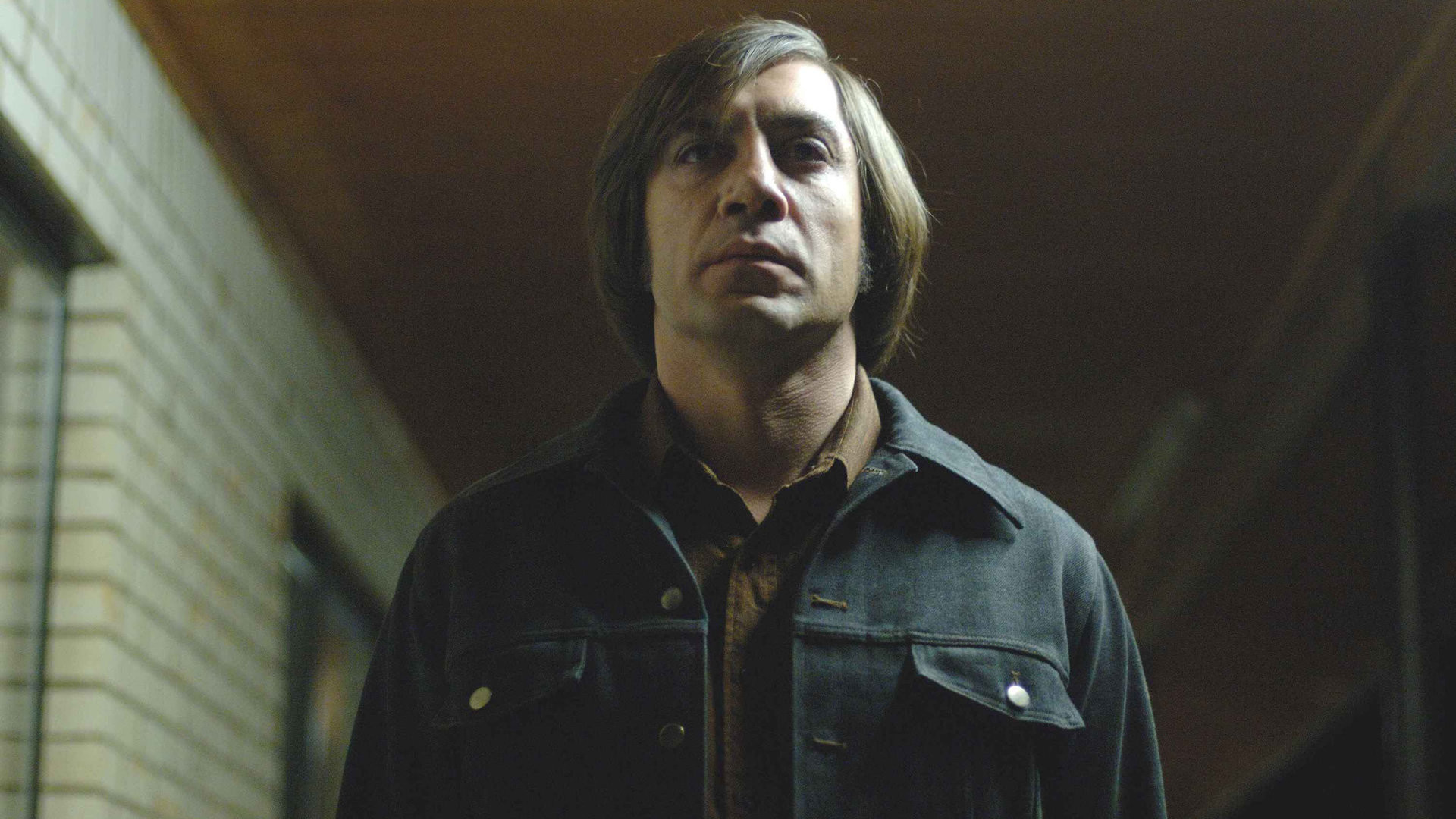 The interesting thing about the chaser in this story, is that he is not your run of the mill sheriff, like in similar movies. No, the antagonist is a serial killer in search of the money that Llewellyn possesses. This gives a classic story a twist
One specific scene that stood out to me was when the sheriff and Chigurh sat in the same spot in front of the TV. When Chigurh is on the couch, you can see his reflection through the television, and then later the same thing happens, but with the Sheriff. He says, "He's seen the same things I've seen" This had an impact because they both literally had seen the same things. It set the scene for the wild chase that was bound to come.

Are there any scenes that specifically stood out to you?
Sunday, December 7, 2014
No Country For Old Men
For me, No Country For Old Men is definitely the most suspenseful of the three fear films we have watched. There is something about the fact that it is a newer movie, as opposed to Psycho and The Shining which are more dated, that makes the fear more real. What caught my eye from the very beginning of the film was the way that antagonist Anton Chigurh went about killing the first two men that got in his way. As a member of the audience, I expected him to use a standard shotgun to kill these men, but was startled, intrigued, and disturbed to see the weapons that he used instead. When he comes across the driver of a car he is trying to steal, Chigurh approaches him and calmly asks him to step out of the car. The driver points out the captive bolt pistol and asks what it is. These are his last words. Instead of immediately putting the pistol to the driver's head, Chigurh draws the moment out for a few more seconds, letting the fear settle in the driver before taking his life. This was the first example of the creative methods that Chigurh uses to murder his victims.
Soon after this in the second example, Chigurh is in the deputy's office awaiting punishment. While the deputy is on the phone facing away from Chigurh, we see the deputy in focus and Chigurh in the background slowly getting up and walking towards the deputy until they both come into the same focus. Chigurh strangles the deputy with his handcuffs, yet another clever way of killing someone. As a hitman, Chigurh has learned that the only way he can get what he wants is to kill everyone who gets in his way. He will also find any way to do it, using whatever resources he has. That explains how he achieved his first two killings. The fact that the audience has to wait for Chigurh to slowly approach his victims creates fear and anxiety, which adds to the suspense factor. What makes the film so frightening is how Chigurh stirs up the audience like this before delivering the pain to his victims.
What I noticed from these two scenes is that Chigurh is not a violent person, although he commits violent acts. He approaches each situation calmly and then snaps into a killing machine.
Besides him being so calm in the terrifying situations he creates, what else is scary about Chigurh?
No Country For Old Men
To me, No Country for Old Men was more terrifying than The Shining and Psycho. While the two horror movies had psychological fears and music to create such a suspense where everyone jumps out of their seats, No Country gave a different perspective. The silence of every scene gave a different type of suspense. You never knew what was coming.


Like the scene when Anton was walking down the motel barefoot. Every step he took gave such n unsettling feeling. By the way he looked and not knowing which room Llewelyn took, you thought he was going to bust down Llewelyn's door and kill him. Even though you saw the killer, you were still shaken up. You knew how murderous and emotionless Anton was. And you knew everywhere he went there would be a death.

Throughout the movie we see how inhumane Anton is. Especially when he cares so little about human life. Especially when he uses the captive bolt pistol normally used to kill animals. Although you see multiple times Anton bring out a coin to decide whether one dies or not. In the scene where he is in the gas station talking about how that one coin that saved the man's life is valuable, Anton seems to care for the life of someone else. He is playing with fate. But is he hoping that fate lets the man live? Or he just playing games?
No Country for Old Men
No Country for Old Men
No Country for Old Men was most definitely a suspenseful movie and hard to predict. An element that was prominent was the use of subjective point of view and parallels between different characters. It was used very minimally and subtly, but it was enough to make the viewer feel like they were in the action of the movie. The most effective portrayal of the subjective point of view is when the camera is placed on the dashboard of the car and filming the road.

I think this method of filming is effective in this movie because like the characters driving in the film, you don't really know where they are going or if they are going to find a place to hide or the person they're looking for.

Another way I thought this movie was made more interesting was the parallels between the reflections of Chigurh and Sheriff Bell in the TV in the Moss's trailer. They both sit down on the couch in front of the window, pick up the glass of milk, and there is a shot of both of their reflections in the empty television screen. I thought this showed the idea that they are both looking for Moss, but each for completely different reasons, but it was interesting that they were both shot in the same way as if they were doing the same things for the same reasons? Were there any other parallels between characters that made the movie more interesting?
No Country For Old Men
No Country For Old Men in my opinion was more terrifying to me than Psycho and The Shinning combined. Although The Shinning and Psycho had both psychological fears, No Country For Old Men was violent, gory, and brutal. When Anton kills the people he was sent to kill he's neither sentimental, nor second guessing. He does it without hesitation which in a sense ties in the factor of psychological fears. Anton's use of the captive bolt pistol makes the deaths of the people he kills seem so inhumane and gruesome. What scared me most in this movie was the use of this pistol because of how it was a gun used to kill animals and Anton was using it to kill humans. It made the whole idea of death seem so unnatural and as if he were killing animals. When really all they were, was just humans.
Towards the end of the movie the viewers see Anton start to have what seems to be emotions when he's talking to Llewelyn's wife. He seems to be almost sad that he has to kill her, but at the same time he really doesn't care because it's his job and it's what he does. In my opinion the scene where he tells her that people always say, "you don't have to do this" is what makes me get the impression that he's over this murdering spell. Do you think that Anton has any true emotions? Does he care about killing Llewelyn's wife?
No Country For Old Men
No Country for Old Men
What I found most interesting about this film is how the director created suspense. I'll admit that while watching Psycho and The Shining, I thought that the only way to create suspense was in the way that Hitchcock and Kubrick did it - through music, sounds, and making every scary scene have a normal setting. However, after watching No Country for Old Men, I realized that I also felt anxious due to suspense created in the film, but for a very different reason.
Unlike Kubrick or Hitchock, the director of this film did not use music to create suspense. Instead, what I noticed is that he used clues to give the audience some sort of knowledge about something so that when this object is later reintroduced in the film, the audience would begin to know what is happening and, in turn, become terrified. For example, one of the very first scenes in the film shows the antagonist, Anton Chigurh, killing an innocent man on the side of a road with an air gun (above). By showing this without even introducing Chigurh prior, the director gives the audience some information about a character. Later, we become scared every time we see his weapon or his use of it, such as his shooting of a door knob before entering a room and killing everyone in it. Every time there is even a slight clue of Chigurh's presence, the audience becomes terrified because there is a large chance that he will kill whoever else is in the scene. This is best exemplified in the scene where he has a conversation with the store clerk. Throughout the entire scene, the audience is terrified that Chigurh will possibly kill the man after they finish talking only because of the prior knowledge of Chigurh that the audience has, not because of music, sound effects, or any special camera techniques.
What other techniques do you think the director used to create suspense?
NCFOM swag
No Country for Old Men was awesome. There are so many moments where the audience is just about to explode with suspense. That is captured through the actors and their amazing performances, and the director.
I think this movie has a a lot more deeper meaning than one might think at first. One scene in particular is the one where Tommy Lee Jones's character goes back to the hotel where Luwellin was killed and the lock is clearly blown out by Sugar's oxygen tank. As Tommy Lee walks in, there is a shot of Sugar hiding. After Tommy Lee sits on the bed, the only thing we see in the vent taken off the wall with the screws and a dime, suggesting that Sugar has the money.

The next time we see Tommy Lee Jones is at the very end of the film. I think it is very possible that Sugar killed the sheriff because at the end of the movie it is the first time we see the Sherriff in any other clothes besides his uniform and the room he is in is flooded with light, much like heaven. It also makes sense because there is no reason Sugar wouldn't have jumped out earlier and just killed the sheriff. Sugar also presumably killed Luwellin's wife and they don't show that. The next shot after their scene is just Sugar walking out of the house.

I think this movie has a a lot more deeper meaning than one might think at first. One scene in particular is the one where Tommy Lee Jones's character goes back to the hotel where Luwellin was killed and the lock is clearly blown out by Sugar's oxygen tank. As Tommy Lee walks in, there is a shot of Sugar hiding. After Tommy Lee sits on the bed, the only thing we see in the vent taken off the wall with the screws and a dime, suggesting that Sugar has the money.
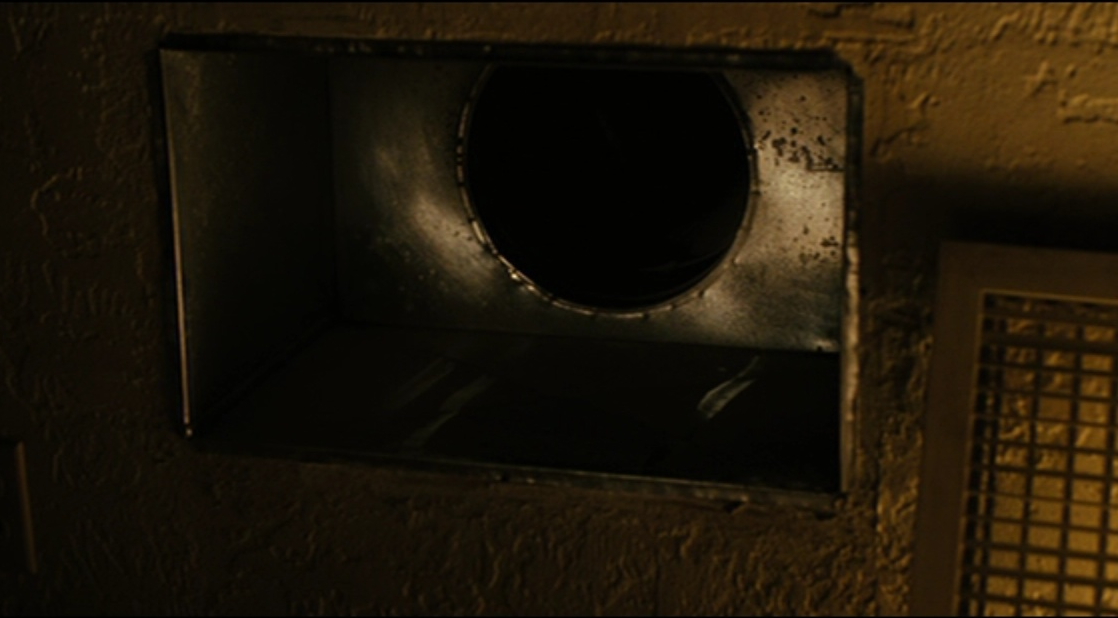
The next time we see Tommy Lee Jones is at the very end of the film. I think it is very possible that Sugar killed the sheriff because at the end of the movie it is the first time we see the Sherriff in any other clothes besides his uniform and the room he is in is flooded with light, much like heaven. It also makes sense because there is no reason Sugar wouldn't have jumped out earlier and just killed the sheriff. Sugar also presumably killed Luwellin's wife and they don't show that. The next shot after their scene is just Sugar walking out of the house.

No Country For Old Men
There is no doubt that No Country for Old Men, is a great film. But what makes it so great? There have been plenty movies about a drug deal gone wrong, or the lives of sheriffs in the vast Western states. I think No Country for Old Men takes these two ideals and takes them in a new direction. The drug deal may have gone wrong, but what is interesting is how it sparks a chase between the protagonist and antagonist for the two million dollars. Also, it uncovers a villain that has a unique approach at committing murder, both with his unusual weapon of choice and his sly demeanor.

However, for me the most interesting aspect about the film is the use of subjective point of view. This point of view is used at various times in the film mostly from the driver of a car. I thought what was unique about the way it's used was that it made me feel as if I was sitting on the hood of the car, not in the drivers seat. And sometimes, the camera seems to be angled towards the road, not straight ahead as the driver would see things. But other times it is angled more upwards like in the picture below:


However, for me the most interesting aspect about the film is the use of subjective point of view. This point of view is used at various times in the film mostly from the driver of a car. I thought what was unique about the way it's used was that it made me feel as if I was sitting on the hood of the car, not in the drivers seat. And sometimes, the camera seems to be angled towards the road, not straight ahead as the driver would see things. But other times it is angled more upwards like in the picture below:

The use of subjective point of view makes the viewer feel as if they are in the action, as if they are Sheriff Bell or Chigurh. I think that this unique perspective that the viewer is forced to take on is what sets this movie apart from others with commonalities. What else do you think helps make this movie different than others with similar themes?
No Country for Old Men

No Country For Old Men

 Cormac McCarthy, all the way down to what could be translated to camera angles. For example, the scene where Chigurh goes to Moss' trailer. In both the book and film, Chigurh blows the lock in with his cattlegun, scans the rooms, takes a carton of milk from the refrigerator, and finally sits down on the couch and "looked at himself in the dead gray screen." (80) This exact shot of Chigurh was used by the Coen brothers, but the most interesting part about it was how they continued to use it. Parallels were a common motif in this film, beginning with both Chigurh and Moss telling their prey to "stand still" before shooting. This shot
created several more parallels between the movies characters in an interesting way too. The first is between Moss and Chigurh again: when Moss arrived home and sits on the couch with Carla Jean, they are filmed in one medium shot. When Chigurh sits on the couch the


No Country for Old Men
No Country for Old Men is a great dramatic thriller film. There is so much intensity from Chigurh simply killing people for his own purpose. Anyone that is a problem or a disturbance to his life, he kills with no second thought. However, the people that didn't necessarily cause any discrepancy and are only trying to get by their own lives he considers their lives within a coin toss. There were a few times were Chigurh came accross people that didn't harm him however he still considered killing them. In those times Chigurh would bring out a coin and ask his subject to call heads or tails. He wouldn't explain what they were calling for and just told them to call one side. Each time, the subject would refuse to call unless they knew what they were calling for. You would think Chigurh would just get annoyed and decied to kill them anyways but the fact that he resist killing them in the first place and gives them a chance to survive shows how he didn't have a true intention to kill them.
What do you think the coin represents?
What do you think the coin represents?
Saturday, December 6, 2014
No Country For Old Men
Noah Pines
Robbins
Film Amalysis
Due: 12/8/14


Robbins
Film Amalysis
Due: 12/8/14
To Kill or Not To Kill
Almost immediately in the film, we see Chigurh (Bardem) take his first victim of the film, strangling the oblivious deputy that was watching him. We then see him pull someone over in his stolen cop car, and he uses an air gun to blow their brains out and steal their car. The third time is different though. He stops at a gas station and gets into an argument with the owner of the station. Chigurh bets the man's life on a flip of his coin.

The man guesses correctly and Chigurh leaves. This is the first time we DON'T see Chigurh kill the first person he sees. But why?
I believe that Chigurh only killed out of necessity; he wouldn't kill someone unless he had a reason to. He needed to break out of jail, he needed to steal the man's car, but he had no reason why he should kill the gas station owner (besides getting into a small argument with him). But that doesn't mean he's not crazy. He killed Carson Wells (Harrelson) simply because he felt that he didn't need him. Carson was sent to find the case full of money, which he did, but he was unable to retrieve it. Chigurh told him that he didn't need to know where it was at that moment, because he already knew where it will be later, set at his feet.

He then killed Carson, because he knew he would get it eventually.
Do you think Chigurh killed Carla Jean Moss? Why?

Friday, December 5, 2014
No Country for Old Men
Gottschalk 1
Lauren Hope Gottschalk
Mrs. Robbins
Critical Analysis of Film and Literature
08 December 2014
No Country for Old Men
I will put it easily, No Country for Old Men was a great movie. I think what made it the great movie
that it is, are the characters. One character that especially stood out to me was Anton Chigurh, the
antagonist, and the unstoppable, murderer that will do whatever he needs to get what he wants. The
immediate focus on how Chigurh has no conscious or moral compass is what makes him most
frightening. Throughout the film Chigurh is killing person after person. With his weapon of a choice,
an air gun, he blasts through door knobs and bodies. Although Chigurh does annihilate anyone that
does or does not step in his way, there were two things that stopped him on two separate occasions.
One was the coin toss, and one was standing up to Chigurh. The time when he enters the gas station
convenience store, and begins to get increasingly annoyed with the owner is the first time the coin
toss is seen (It is not known if Carla Jean Moss was killed or not). It seems that Chigurh's choice of
either killing someone or not is based on odds. The coin is flipped, the victim guesses correctly, they
live. The coin is flipped, the victim guesses incorrectly, they die. Chigurh can't even decide for
himself whether to kill the person or not, he leaves it to a coin.

The second instance where Chigurh let someone go free was when he was looking for Llewellyn
Moss. He goes to the woman that controls Moss's home, and the surrounding homes. The woman
gives Chigurh a disrespectful tone which to the viewer would signal that she is going to be killed, yet
Chigurh leaves the woman perfectly intact.

It seems as though Chigurh has his own moral code. Although this code of his is
very different from the average person, it is what distinguishes right from wrong to him. The man at
the gas station hit a more disrespectful nerve in Chigurh then the lady that deals with the trailer park.
Therefore, Chigurh executed the coin toss with the owner of the gas station.
Why is it shot that the viewer can not see if Chigurh killed Carla Jean Moss, or not?
Subscribe to:
Posts (Atom)