When watching Annie Hall, not many things cinematographically stood out to me, but there was something that I thought was very interesting - the way Woody Allen filmed flashbacks. He didn't film them like they were filmed in Casablanca or Citizen Kane, where they were achieved through dissolve, but instead as if his older self was still in the scene, observing himself in younger years. I thought this filming technique was very innovative an extremely original even for 2014. Also, instead of just observing himself, he also had himself and the other characters with him at the time actually interact with the characters of the past.
For example, when he gets invited for the first time to Annie's house to have dinner with her family, there is a scene in which the screen splits into two halves and Annie's family interacts with Alvy's family. I thought this was incredibly interesting because the two families were not actually in the same room to actually talk, but they still had dialogue.
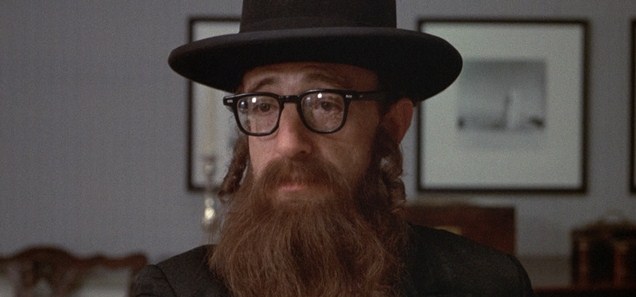
There are many scenes of this sort: for example when Alvy and Annie go to two separate psychiatrists, the split-screen method was used to show contrasts between the two. For example, Annie's room was completely white and everything in her setting was illuminated by light. We know that her psychiatrist is a woman, because we hear her voice, but we don't know what she looks like. Annie is sitting, wearing business-casual clothing, and talking about her problems. Alvy's room, on the other hand, was dark and gloomy. We actually see his psychiatrist, but he does not speak. This shows to us the complete polar opposites of Alvy's and Annie's crisis, although they are mutually experiencing not only difficulties in their relationship, but as revealed later, the discomfort they feel that they are paying for two very unhelpful psychiatrist sessions.
There are also other tidbits of this similar technique in other parts of the movie: when Alvy is in his childhood classroom as an adult but observes his classmates and himself as small children, and when Alvy witnesses a family gathering in the 1940s with his crazy "nickel" uncle are both examples of this.
Sunday, October 19, 2014
Saturday, October 18, 2014
Annie Hall
Scott Yarmoff
Mrs. Robbins
Film Analysis Period 3
10/18/14
Mrs. Robbins
Film Analysis Period 3
10/18/14
Rulebreaker Annie Hall
I have never seen a movie break as many rules as many times as Annie Hall. Alvy would talk to the audience many times which is very unusual for a character in the plot. Multiple characters would be in the same room as people from many years ago, including themselves. Characters from different times and places would interact. Alvy would talk to random people who would openly talk about their lives even in ways that they would never truly say out loud, like saying that they are shallow, and even talking to a cartoon. This film is clearly a comedy, but even so, how did they get away with all of these techniques and not look like a mess of a film? All of these things were clever and well put together instead of being confusing like it very well could have been. That takes some incredible writing and directing.
Annie Hall
In the film Annie Hall, directed by Woody Allen, expresses many unique techniques of character display this isn't commonly used. The most significant use of character expression in the film is when the main protagonist, Alvy Singer, almost pauses the story of the film and talks directly into the camera as if he is speaking to the audience. This happens a few times during the film and when he does this is usually at a time of conflict where he feels the need to explain himself and his perspective. As Alvy does this everything around him is still moving and alive however the audio only focuses on Alvy's voice and the camera is still in wide view however all the other characters aren't directly paying attention to the camera itself therefore only Alvy is focused on. As he does this he has full control over the other characters around him and enables him to see their reactions to the situation and respond to his questions on the issue.
The scene that stood to me the most that used this method of character expression is when Alvy and Annie and waiting in line to see a movie. A man behind them is critiquing anther film which agitated Alvy greatly because he believe this man had no proper knowledge of any film analysis. As this is happening Alvy takes a pause from arguing with Annie about this and begins letting out his frustration as he speaks towards the camera. This became more interesting once the man who was annoying Alvy almost comes to life in this pause of reality to counter argue Alvy. This gets even more interesting once Alvy brings in the director of the film they were talking about just to prove his point and express to the audience his control over the things around him in aspect of demand.
Do you think this technique was distracting from the actual story of the film or added more character analysis?
(http://fairuselab.net/2012/04/27/mcluhan%E2%80%99s-cameo-scene-in-%E2%80%9Cannie-hall%E2%80%9D/)
The scene that stood to me the most that used this method of character expression is when Alvy and Annie and waiting in line to see a movie. A man behind them is critiquing anther film which agitated Alvy greatly because he believe this man had no proper knowledge of any film analysis. As this is happening Alvy takes a pause from arguing with Annie about this and begins letting out his frustration as he speaks towards the camera. This became more interesting once the man who was annoying Alvy almost comes to life in this pause of reality to counter argue Alvy. This gets even more interesting once Alvy brings in the director of the film they were talking about just to prove his point and express to the audience his control over the things around him in aspect of demand.
Do you think this technique was distracting from the actual story of the film or added more character analysis?
(http://fairuselab.net/2012/04/27/mcluhan%E2%80%99s-cameo-scene-in-%E2%80%9Cannie-hall%E2%80%9D/)
Friday, October 17, 2014
Annie Hall
One thing that stands out to me in Annie Hall, was the use of "fun" effects that we, as a class, have not seen in any of the films we have watched so far. My favorite was when Alvy would turn to the camera and talk to the viewer. To me, it made me feel as if he was just talking to me and no one else in the room. I think that he did this to create a more intimate feeling among the viewers and the characters. It made it feel as if you were personal friends with Alvy and you were actually talking to him face to face.
Another interesting effect that stood out to me was the use of split screen. Although I have seen split screen in other films and T.V. shows, I thought the one in Annie Hall, was especially unique. When the screen is split between Annie and Alvy and the other characters, I noticed that the screen in unevenly split; it is not half and half, it is three fourths and a fourth, with the majority being focused on Alvy. This was done in order to focus more on Alvy feels, rather than Annie, because after all, Alvy is the protagonist. Also, I think that the splitting of the screen shows just how different they are as people, which is ultimately an insight to why they break up by the end of the film. It is almost used as foreshadowing.
These two effects enhance the witty aspect of not only Alvy, but the film as a whole. What other effects do you think possibly help add to the clever, and humorous nature of Annie Hall?
Annie Hall
On all fronts, Annie Hall is a brilliant film. The dialogue is genius to the point of frequent hilarity, and the varying techniques used to convey different aspects of Alvy's personality are very well incorporated. I'd like to touch on the film's point of view. Although the film is shot objectively, with us observing the events, there seems to be something slightly off about the characters and settings. This effect is heightened by Woody Allen's writing. In my opinion, this is done to show that everything, although objective, is from Alvy Singer's point of view. Because of his paranoia and seemingly manic depressive nature, everything seems a bit exaggerated and particularly unjust or unfair to Alvy. For example, he always judges people as stereotypes of one kind or another. For example, to Alvy (and the audience), everyone in California seems to be a pretentious, artistic, phony. Annie's family appears to him as something out of a Norman Rockwell painting, as he comments in the film. We can also look at scenes like Alvy's conversation with Duane. Perhaps Duane wasn't really sitting in the corner of his dark room, and perhaps he didn't describe his dark fantasies in such grim detail. Perhaps this is just how Alvy saw it. His paranoia of course, is brought out in the true events of the film, such as his accusations of anti-semitism (one of which is right).
Do you think Woody Allen intended all of this?
Annie Hall
Lauren Hope Gottschalk
Mrs. Robbins
Critical Analysis of Film and Literature
17 October 2014
Annie Hall
Woody Allen used many different and stylistic techniques through the film Annie Hall, yet one was especially outstanding to me that has not been seen in any of the films that have been watched in this class thus far. When Alvy Singer needed advice and seemed confused about his relationship he would begin to talk randomly to people that were walking down the street or in social places. He would ask them questions that would personally pertain to his life and the street walkers would respond like they were friends of Singer's.
It was not expected that Singer would walk up to someone random and explain his relationship questions. This approach paid off because it made those parts of the movie humorous.
Wednesday, October 15, 2014
The Graduate
The ending of The Graduate leaves a large amount of room for interpretation. The song, "Mrs. Robinson" is manipulated to give the final scene of Benjamin racing to stop Elaine's wedding a suspenseful feel and a more dramatic mood.
The original tempo of "Mrs. Robinson" here is manipulated in sync with the diegetic sounds; being both accelerated when Benjamin is driving frantically to Santa Barbara and slowed down when his car runs out of petrol.
The rhythm fades as the car slows down and Benjamin jumps out to run the rest of the way to the church. The contrast between the changed rhythm of "Mrs Robinson" and the noises of the wind and passing cars while Benjamin is running creates even more suspense.
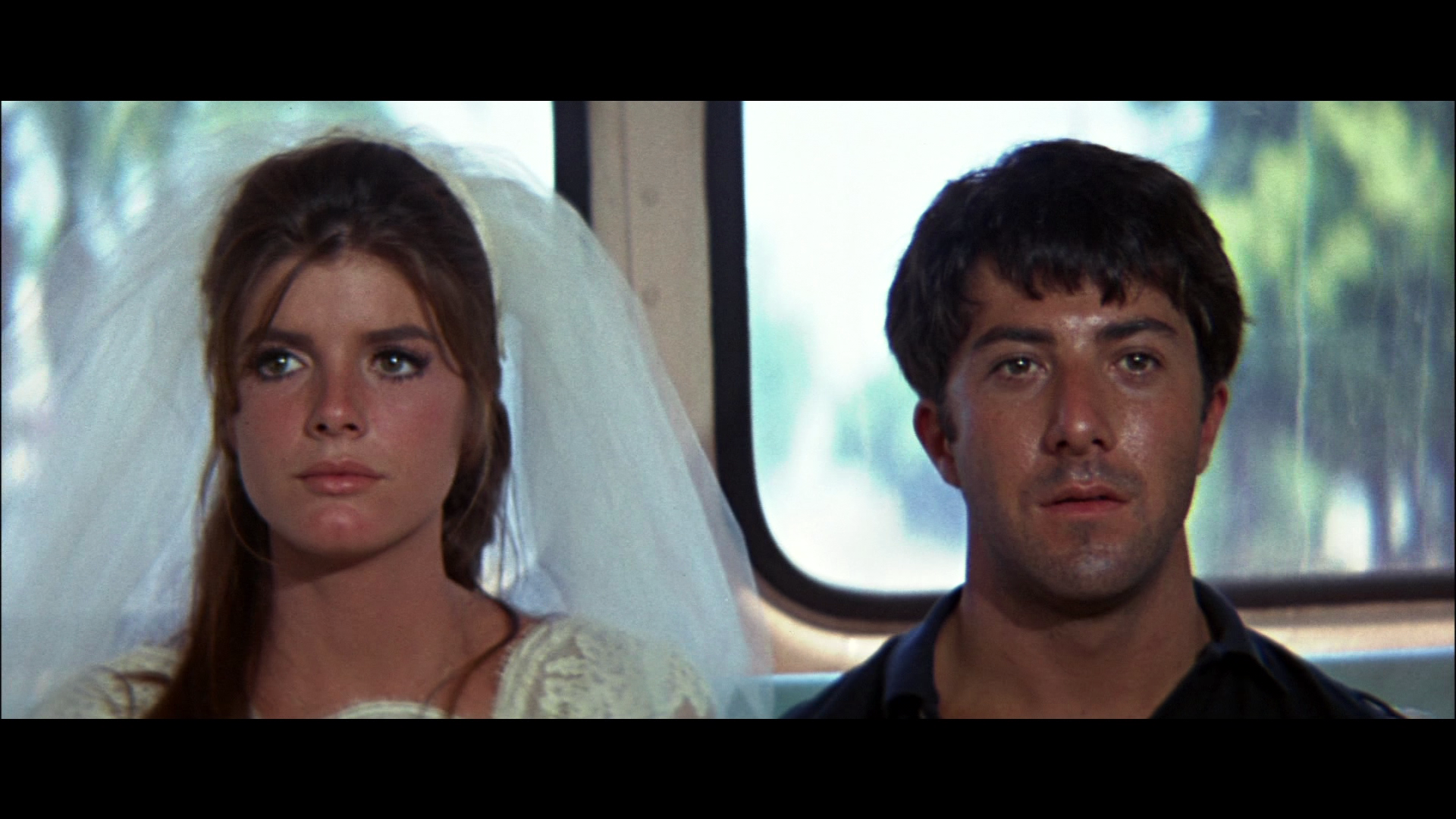
The final shot of The Graduate is of Benjamin and Elaine on a bus. It slowly starts driving away from their previous, planned out lives while their facial expressions turn from happiness to sense of anxiousness.“The Sound of Silence” starts to play; a song, in my opinion, that describes Benjamin’s feeling of dissatisfaction and isolation. I think that through sound and suggestion, The Graduate closes on an confused note, leaving plenty of room for interpretation. How do you believe the movie ended and would you change anything about it? Do you think the music or the images have more of an effect on the movie’s final scene?
Tuesday, October 14, 2014
The Graduate
As we watched the film and discussed its soundtrack by Simon and Garfunkel, the song "The Sound of Silence" stood out to me among the others. The reason for this lies in the first line, "hello darkness, my old friend." We hear it in the first scene of the movie as Benjamin stands on the moving walkway in the airport, completely emotionless. Because he seems so deep in thought during this scene and throughout the movie, I was wondering if he has a history of depression or sadness. He is unsatisfied with his life and unaware of his abilities to succeed in life. He spends a lot of time at home and doesn't have the motivation to do anything, which his parents point out multiple times. An observation I just made is that when he is in the pool or looking at/near water, he is reflecting on his life as he watches the water. This brings me to the next time the song begins to play, which is after he and Mrs. Robinson fornicate in the hotel, the first time. As the song plays, he transitions from the pool/his house back to the hotel scene, as if each door leads him back to the memory of the night before. He must feel guilty for what he has done, which is why the darkness is coming back to him. However, The last time the song is heard is at the very end of the movie, where Benjamin and Elaine have just escaped her wedding and gotten on a bus. They are smiling and exhilarated, and when the song begins, Benjamin is smiling, which is ironic considering the lyrics of the song. To me, this showed that he has overcome the darkness he once felt inside of him. He is finally doing something that makes him happy, which he has never had for his whole life.
Are there any other songs in the movie that are significant/show as much of what Benjamin is feeling as this one?
Monday, October 13, 2014
The Graduate
During the movie The Graduate something that lingered in the back of my mind was what was motivating Mrs. Robinson to seek this relationship with Ben. After re-watching a number of scenes it becomes apparent that Mrs. Robinson is looking for youth.
Youth is a big theme from The Graduate and Mrs. Robinson is a symbol for the future or the longing for youth. In the scene when Mrs.Robinson invites Ben back to her house, and she tries to tempt him which leads to Ben accusing her of seducing him, she takes it as a compliment instead of an insult. This alone how all she wants is somebody younger to want to have feelings for her and make her feel like she is young not old and washed out. In that same scene when Mr. Robinson comes home, he talks about how you can never be twenty-three again. This scene is what shows us that Mr. and Mrs. Robinson both regret decisions they made when they were younger and wish they ventured out and had flings instead of tiring the knot.
An important way to show this longing for youth from Mrs. Robinson is how she is clothed throughout the movie. In almost every scene between her and Ben she is wearing clothes that women who are old mothers and married shouldn't be wearing especially cheetah print. This all tells the audience that Mrs. Robinson has a serious insecurity problem about age and tries to make up for it by wearing flattering clothes.
The whole relationship between Mrs. Robinson and Ben also felt like Mrs. Robinson using Ben as almost vitamin D, keeping her young and healthy. In an odd way she was sucking the life out of him and putting him in a position where she was taking his youth and he was losing it. The director shows this by having Ben do nothing but be with Mrs. Robinson instead of doing what normal twenty something year olds should be doing.
Another way the director showed us Mrs. Robinson was searching for youth was the rack focus in the scene Elaine finds out Ben has been having affair with her mother. I believe the rack focus in this scene shows that Ben has replaced her with something younger and it is the only scene Mrs. Robinson isn't in make up. The camera is focused on young Elaine and when it switches focus to Mrs. Robinson it shows her wrinkled and older than ever shown, hinting to the audience that Mrs. Robinson wasn't getting her youth anymore from Ben.
![]() |
| Provocative Clothing on Mrs. Robinson |
The Graduate
The Graduate
Throughout the movie The Graduate by Mike Nichols I picked up on the use of motifs and how they were significant. The first time you see a motif used is when Mrs. Robinson sneaks in on Benjamin while he is in Elaine's room. You see Mrs. Robinson's reflection through the portrait of Elaine which represents how she is trying to act younger than she is. She is trying to act like her daughter would. It also shows how she has to be secretive about what she is doing because what she's doing in proper and shouldn't be done.
Another scene where you see motif being used is in the scene where Mrs. Robinson comes to meet Benjamin at the hotel bar. You see her reflection upside down which represents how upside down this whole affair is. It represents how this is so unusual and just messed up.
Towards the end of the movie you don't see the use of motifs used anymore because he's in love with Elaine and she doesn't have to prey on him. She doesn't have to act immature in order to win him over. Mrs. Robinson had to sneak up on him and persuade him into having an affair with her while you always saw Elaine. You always saw her without surprising Benjamin. Do you think that motifs should've been used around Elaine? Do yo
The Graduate
The Graduate is a story of whirlwind romance, obstacles, and pure coincidence. What are the chances that someone falls in love with the daughter of their secret lover, who also happens to be one of their parents' best friends, and she disappears to go to her wedding?! I'd say slim to none. Well besides the chances, it happens to Benjamin, and it happens fast.
During his affair with Mrs. Robbinson, Ben's curiosity overcomes Mrs. Robbinson's choice to involve no emotions. As her past is uncovered we learn all about the grudge she holds against her own daughter because she is the reason why she has had to endure a dying marriage. Ben is forced to promise her that he will never ask Elaine out, even if its against the wishes of all the other adults in his life.
Besides the promise, Ben is forced into a date with Elaine, which turns into true love.
But do we know that these too sweet-hearts are really in love?
I question this with due reason, based on the last frame in the movie. Once the rush of pulling Elaine out of her wedding, and running away to the nearest bus station, the couple's enthusiastic expressions fade away and more questioning looks begin to overwhelm them.
I believe that this is the reality setting in. They had just made a very bold move, and it was hard to process what was actually going on until it was over. Although I think in some way they do love each other, just like the Robinsons, the reason why they were both so devoted to each other was not only love, but the thrill of the chase.
The couple was so fixated on getting to the point of relaxation that they never had time to really let their emotions play out. Now that they've run away and embarrassed their family, can they really turn away from each other if their relationship dies?
Will the young couple end up like the Robinsons?
During his affair with Mrs. Robbinson, Ben's curiosity overcomes Mrs. Robbinson's choice to involve no emotions. As her past is uncovered we learn all about the grudge she holds against her own daughter because she is the reason why she has had to endure a dying marriage. Ben is forced to promise her that he will never ask Elaine out, even if its against the wishes of all the other adults in his life.
Besides the promise, Ben is forced into a date with Elaine, which turns into true love.
But do we know that these too sweet-hearts are really in love?
I question this with due reason, based on the last frame in the movie. Once the rush of pulling Elaine out of her wedding, and running away to the nearest bus station, the couple's enthusiastic expressions fade away and more questioning looks begin to overwhelm them.
I believe that this is the reality setting in. They had just made a very bold move, and it was hard to process what was actually going on until it was over. Although I think in some way they do love each other, just like the Robinsons, the reason why they were both so devoted to each other was not only love, but the thrill of the chase.
The couple was so fixated on getting to the point of relaxation that they never had time to really let their emotions play out. Now that they've run away and embarrassed their family, can they really turn away from each other if their relationship dies?
Will the young couple end up like the Robinsons?
Sunday, October 12, 2014
The Graduate
I thought the very last scene of the film was interesting. After Elaine and Ben have made a daring escape, interrupting and cutting her wedding short, and anger her parents, they run off together and get on a bus. The last shot lingers on their faces as they sit on the bus. At first, both are laughing and smiling and looking at each other. This gradually goes away, and they switch between regular faces and smiles, and looking at each other and looking forward. Finally, they both end up looking straight faced forward, toward the front and not at each other. I thought this was interesting because it seems like the two of them are having second thoughts about their hasty escape. Neither really thought it through, and it was very spur of the moment. Now that they have a moment, they are back where Ben was at the very beginning: unsure of the future and what is to come. The song also returns to something a little less bright, playing "Sound of Silence".
The Graduate
The film The Graduate didn't strike me as a very funny film (granted it did have it's moments). However something that did strike me was the impressive use of water and reflective surfaces as a motif in the film. Ben seems to find a mix of solace and comfort when around or at times within water, but yet many of the film's unfortunate circumstances are relayed through a reflective surface.
For example, Ben only seems to be at peace during the film whilst in his pool, or while looking at the fish tank he has in his room. The moments where he is doing either of these things are either during or after moments of duress, such as the welcome home party, and whilst he's having an affair with Mrs. Robinson. Even immediately after moments of duress, such as when he's practically humiliated while in a diving suit in front of his family, the water brings Ben peace. The motif of water is never directly addressed, and one could only guess why he finds it to be so calming.
Reflective surfaces on the other hand are often a source of duress for Ben. At various times, Mrs. Robinson can be seen only through a reflective surface, A good example of this is when she meets Ben at the hotel for the first time, just before they begin their affair. Mrs. Robinson seems to suddenly appear as the camera only shows her reflection on a table. This heightens the manipulative personality of Mrs. Robinson, that she can appear and disappear in Ben's life on a moment's notice. During their affair, she frequently does this.
Another stressful situation shown through a reflective surface is at the very end of the film, when Ben is banging on a glass window shouting Elaine's name, trying to get her attention so that she wouldn't go through with her marriage.
The film The Graduate has numerous motifs, and the motif of water and reflective surfaces is just one of the group.
The Graduate
I haven't seen anything this funny in a while. Dustin Hoffman is absolutely hysterical. His comedic timing is supreme and his delivery of lines is so dry. A good example is when Ben tells his parents that he is going to marry Elaine, but hasn't actually talked to her about it yet. The way he says everything is just so blunt and very funny.
Something I thought about after seeing the film made me laugh. There is the typical situation of a guy having some sort of fling/confrontation/relationship with a girl and then he gets with that girl's best friend. Its just a bad situation to be in. Both girls get in a fight and eventually turn on the guy. Not good. I was thinking that's bad enough but Ben didn't get with Elaine's friend. Her mom! I couldnt imagine anything worse.
Aside from the great comedy in the film, the use of film is very key and effective. I love the idea of using all Simon and Garfunkel songs. I think they are such good songwriters and the lyrics played so well into the scenes. I found it fascinating that The Sound of Silence was played three times throughout the movie. I feel like it is rare that the same song is even played twice.
This was one of those films when you go back to it, you would be hard pressed to find anything that you would want to change. It is a very funny movie, but has the right balance of real aspects of people's lives that we can all relate to. Example: figuring out what we are going to do with out future.
Something I thought about after seeing the film made me laugh. There is the typical situation of a guy having some sort of fling/confrontation/relationship with a girl and then he gets with that girl's best friend. Its just a bad situation to be in. Both girls get in a fight and eventually turn on the guy. Not good. I was thinking that's bad enough but Ben didn't get with Elaine's friend. Her mom! I couldnt imagine anything worse.
Aside from the great comedy in the film, the use of film is very key and effective. I love the idea of using all Simon and Garfunkel songs. I think they are such good songwriters and the lyrics played so well into the scenes. I found it fascinating that The Sound of Silence was played three times throughout the movie. I feel like it is rare that the same song is even played twice.
This was one of those films when you go back to it, you would be hard pressed to find anything that you would want to change. It is a very funny movie, but has the right balance of real aspects of people's lives that we can all relate to. Example: figuring out what we are going to do with out future.
The Graduate
After a bumpy ride with Ben, Elaine, and Mrs. Robinson, we end up with a storybook ending. The guy (Ben) gets the girl (Elaine) and the big bad witch (Mrs. Robinson) loses. In a lot of ways The Graduate is like a fairytale (a very weird and disturbing one). From the start of the movie we have the main character, the perfect son, Ben come home from college. His life is mediocre at best, and he is in need of some excitement. As every fairytale goes, the hero (Ben) wants something and that something happens to be independence, and even being a bit daring. That is where our villain, Mrs. Robinson, comes in. The one person who can make all of our hero's wishes come true, but at an unseen cost. She tricks Ben into having an affair with her, so he can feel independent. All is good, until the love interest, Elaine, steps into the picture. Our brave hero cannot help, but fall in love with her. When there seems to be nothing that stands in the way of them, the villain strikes back. Mrs. Robinson forbids Ben from ever seeing Elaine, and if he does she will expose him. Well, in every fairytale it seems that there is nothing the hero can do to win. When all hope is lost our hero comes up with a brilliant, yet unlikely plan. Ben decides to break up the wedding and win Elaine back. After traveling a long way, his seemingly impossible plan seems to have a chance. When Ben confronts Elaine and tries to win her back who is there of course? Mrs. Robinson, our cunning villain. In a last ditch effort to foil Ben's plans she tries to say, "It's too late". Of course this doesn't stop Ben and Elaine from running into the sunset happily ever after.
So what am I getting at? Is The Graduate, just another (more mature) fairytale, or is there a hidden meaning within all of this.
The Graduate
Throughout the class film, The Graduate, the protagonist, Ben, is every parent's dream. He was the track star, won several awards, and achieved various other successes. In the beginning of the film, Ben's parents throw him a graduation party, but none of the guests are Ben's age. The party was just another way for his parents to brag about Ben's achievements to their friends. After graduating from college, Ben realizes that he is indeed, his parents' dream, not his own. Up until this point in his life, all of his decisions were made for him, but suddenly he was the one to choose his life path. Ben felt a lot of pressure from his parents to do something with his life. They constantly asked him what his plan was, and when he was going to act on it. In one scene, as Ben floats around in the pool, his parents come up on either side of him, circling him like sharks. They attack him with more questions and it is clear that they drove him over the edge. Because of these pressures Ben faced, he made several bad decisions in spite of his parents. The first one was sneaking off to see Mrs.Robinson. This affair was highly inappropriate and Ben knew his parents would never approve of it. Ultimately, this affair did not make Ben happy, he still felt empty and lost. The affair stretched on for months, and in that time Ben still did not know what he wanted to do with his life. Another bad decision Ben made was crashing Elaine's wedding. This was a rash decision, and this choice, in the end, did not make him happy either. In the final scene, the camera stalls over Ben and Elaine's face as they ride away on the bus. At first he is laughing, but his face becomes much more solemn as he realizes the repercussions of his actions. Although he may have thought marrying Elaine would be the next step in his life, it didn't really change anything. He still has no job, no house, and now he has a bad relationship with his parents.
Although Ben's parents thought they were doing what was best for their son by raising him to be idealistic, they ultimately hurt him by making all of his decisions for him. When Ben was finally allowed to make his own decisions, he didn't know how to and made several bad choices. Do you think that Ben's failures were his parent's fault, or his?
The Graduate
In the final scene of The Graduate, Ben breaks his silence in efforts to win Elaine back by disrupting her wedding. Throughout the film, we see Ben start off as a very passive character, one who wants to please those around him and fails to identify with himself and his actions. As we get deeper into the plot, and the relationship between Mrs. Robinson and Ben progresses physically yet Ben takes an interest mentally in Elaine. Up until he dates Elaine, I don't believe that Ben was ever fully content with himself despite all of his previous achievements and awards. Elaine helps him enjoy life again and experience happiness- something that he didn't experience much of with Mrs. Robinson. In the moments leading up to the last scene, we see a very demanding side of Ben who will stop at nothing until he has Elaine back in his life for she is his ultimate goal. The thing that I love most about the ending after Ben grabs Elaine and hops on the bus is the look of uncertainty and blankness on their faces. They realize what they've just done by essentially messing up the status quo and even though they were so confident in their decision five minutes ago, they're now processing what just took place and how their future is wide open. Does all marriage begin with a certain sense of uncertainty? Should one be 100% confident in their spouse/decision?
The Graduate
In the film, there is a lot of use of water. We first see the use of water when ben is sitting by his fish tank. He was sitting there trying to get away from his parents and the party they were having for him. At first the fish tank is something that Ben goes to for relief, to just get away. But in another scene you Benjamin in scuba gear that his dad gave him for his 21st birthday. When he jumps into the pool it zooms out to where Ben looks like this little guy in a big empty space. Representing his out look on life. He doesn't know what to do. He's lonely in this big world. Lastly you see Ben in the pool on a raft while his parents circle around him because they want him to take Elaine out for dinner. While his parents are talking he occasionally put his head in the water. Ben would do this to block out what his parents were saying. He didn't want anything to do with Elaine because of Mrs.Robinson. He tried blocking it out like he does for other things like his father wanting him to go to Grad school.
The Graduate
The music in The Graduate wasn't created originally for the movie's soundtrack, but all of the songs were able to express Ben so well that no new material was needed for the movie. The movie became even more important to the story towards the end of the film, when it shifted from a satirical comedy to have a more romantic theme. The song "Scarborough Fair" plays a significant role in Ben and Elaine's relationship after Elaine finds out about Ben and Mrs. Robinson's affair. When Ben follows Elaine to Berkeley, the song is played as he searches for her on campus and only ends when Ben comes in contact with Elaine on the bus going to the zoo. The song begins again after Elaine leaves Ben in front of the monkey house to go with Carl. The song ends again when Elaine comes into Ben's apartment and an instrumental version starts when Elaine leaves, specifically the tune of the lyric "she once was a true love of mine", signifying that Ben really does love Elaine, and she is "the one that got away".
The Graduate
In The Graduate, Mike Nichols uses music and montages to unravel desperate times. Specifically 'Sounds of Silence' has a huge significance to the film and they play the song several times over; significantly three times, beginning, middle and the end. Whenever I heard the song the lyrics referred to silence as almost an illness. The people in the film lacked honesty and confidence in talking to one another, a lot of the problems would've been solved.
'Sounds of Silence' helps introduce Ben as a character, and illustrating his feelings of isolation and alienation. This is shown in the first scene where the music works well in playing while on the automated walkway in the airport. The white background illustrates isolation and blankness, as is apparent in his expression. This portrays him in being a sleepwalker which in many ways, that is what he is.
'Sounds of Silence' plays again at the hotel when Ben and Mrs. Robinson meet up and the door is closed, as there is a fade to black. During this song there is a montage showing Ben going through a repetitive daily routine, leading up to an evening in the hotel room for sex. It comes up again how we were introduced to Ben as a lonely detached character, as there is no dialogue just a set up routine that has occurred his whole life. Furthermore, we see him this way in activity that should be fun and intimate.
'Sounds of Silence' helps introduce Ben as a character, and illustrating his feelings of isolation and alienation. This is shown in the first scene where the music works well in playing while on the automated walkway in the airport. The white background illustrates isolation and blankness, as is apparent in his expression. This portrays him in being a sleepwalker which in many ways, that is what he is.
After the affair and dramatic break up with Elaine Robinson, Ben's confidence increases as he makes the plan to go to Berkeley without hesitance which contrasts to the way he was with Mrs. Robinson. Ben disrupts the wedding and he and Elaine flee together. 'Sounds of Silence' is the same song that ends the movie, that began the movie. As this song plays, the final shot of Ben and Elaine reveals that neither of them seem secure, or certain after the decision they've made and it demonstrates the disconnectedness at what could've been a happy ending.
Do the lyrics in the 'Sound of Silence' mean something greater than the idea of isolation?
The Graduate
The ending of the film The Graduate is a very iconic scene, and one that has been referenced and parodied many times in popular culture. However, in my opinion, the most interesting thing about the scene is the way in which it misleads the audience. For a first time viewer, the film has an incredibly happy ending. Ben gets the girl and humiliates the sinister Mrs. Robinson. They vide off into the sunset together and live happily ever after. However, let us think about the implications of the scene. Elaine has just run out on her wedding, and infuriated her parents by marrying the "wrong" man. I don't think that either of them will ever be welcome home again after this. The biggest implication of this is the final two shots of the film. As Ben and Elaine sit in the back of the bus, the smiles slowly fade from their faces as the somber melody kicks in. The bus then speeds on into an incredibly uncertain future. (Not to be negative or anything!)
Do you agree, or do you think that this is more of a classic, happy movie ending?


Do you agree, or do you think that this is more of a classic, happy movie ending?
The Graduate
In the last few scenes of the film, the music becomes extremely important to the story line, especially through the song "Scarborough Fair/Canticle." The first time it's heard, Mrs. Robinson had just told Benjamin goodbye, and there is a following montage of Benjamin going back to staring at his fish tank and pool, as well as stalking the Robinson home. The lyrics match up pretty well with the storyline- the song is about a man trying to win his true love, as the herbs used in the lyrics represent virtues (Parsley was comfort, sage was strength, rosemary was love, and thyme was courage). Ben loved Elaine at this point, but as she clearly didn't feel the same way, he had to find a way to win her back. The song ends when Ben tells his parents that he was going to marry Elaine Robinson, which was his idea of a plan to make her love him.
The next time Scarborough Fair starts, Ben is driving up to Elaine's college... which is only about a minute or so after the song ended the first time. The song's overall mood doesn't fit as well this time, because Ben is on an impossible quest. Elaine hates him, and she doesn't want to see him, much less marry him.

But again, Scarborough Fair plays a mere minute after the last one ended, except this time the song is just instrumental as Ben watches Elaine on her campus. The song then plays twice more, once after Elaine leaves Ben in front of the monkey exhibit at the zoo, and for the last time when Elaine asks Ben not to leave, not until he has a definite plan for himself. The song progresses this way because the lyrics talk about a man trying to win his true love, just like how Ben begins to win Elaine back through the impossible task of convincing her to marry him. Slowly though, his plan begins to work, and so the song just becomes instrumental, then only a portion of it is played, until finally, only the ending of the song is played when Elaine gives in to Ben.
Is this an accurate analysis of the song, and even if so, why do the remainder of Scarborough Fair lyrics contain references to a war? Is this because Ben's love life is a battlefield, or because he battled between the two Robinson's before deciding he loved Elaine?
The next time Scarborough Fair starts, Ben is driving up to Elaine's college... which is only about a minute or so after the song ended the first time. The song's overall mood doesn't fit as well this time, because Ben is on an impossible quest. Elaine hates him, and she doesn't want to see him, much less marry him.

But again, Scarborough Fair plays a mere minute after the last one ended, except this time the song is just instrumental as Ben watches Elaine on her campus. The song then plays twice more, once after Elaine leaves Ben in front of the monkey exhibit at the zoo, and for the last time when Elaine asks Ben not to leave, not until he has a definite plan for himself. The song progresses this way because the lyrics talk about a man trying to win his true love, just like how Ben begins to win Elaine back through the impossible task of convincing her to marry him. Slowly though, his plan begins to work, and so the song just becomes instrumental, then only a portion of it is played, until finally, only the ending of the song is played when Elaine gives in to Ben. Is this an accurate analysis of the song, and even if so, why do the remainder of Scarborough Fair lyrics contain references to a war? Is this because Ben's love life is a battlefield, or because he battled between the two Robinson's before deciding he loved Elaine?
The Graduate
Something I picked up on in The Graduate was the use of color, particularly through costumes. In the beginning of the film, and well into the middle, the characters wore strictly black and white outfits that coordinated with the oftentimes black and white backgrounds. But unlike in Casablanca, where the difference between black and white costumes symbolized “good and bad” characters, in The Graduate, I feel as though these stark contrast between black and white costumes was meant to tell the storyline. It is only in the beginning that characters are only dressed in dark and light colors. As the story unfolds, new colors are introduced. That to me showed that there was a clear difference in characters and their intentions. As new colors such as navy blue, pink, and camel, are slowly embedded in the costuming, the plot, specifically relationships, becomes melded together (Ben, Mrs. Robinson and Elaine), it isn’t so black and white anymore. Also, the first time you see a character wear a color that is not black or white is when the audience is first introduced to Elaine, when her and Ben go on their first date. She is wearing a pink dress, which showed that she will be a significant later in the movie; she isn’t just wearing black and white like the rest of the characters.
It is clear that the use of color had a deep meaning throughout this film. It illustrates how the characters grow and change. What other motifs or details show the development in character?
Saturday, October 11, 2014
The Graduate
Noah Pines
Robbins
Film Analysis
10/13/14
Robbins
Film Analysis
10/13/14
The Graduate
Dustin Hoffman does an incredible job playing Benjamin Braddock in The Graduate. Ben changes from being a submissive, timid boy to a strong, brave "go-getter". While the movie is a comedy, Ben is very glum through most of the movie, and some of the funny moments even spawned from his awkwardness. There were really only two times that we see Ben actually happy, during his date with Elaine and when he runs off with her at the end.
Ben was stuck in an affair with Mrs. Robinson mother of Elaine and wife of his father's business partner. Ben would do whatever she said, and when he tried to object, she would trick him into doing what she wanted anyway. Meanwhile, not knowing what was going on, Mr. Robinson and Ben's family forces him to take Elaine out on a date, and Ben falls in love. Mrs. Robinson threatens to reveal the affair if he took Elaine on another date, but Ben breaks the news to Elaine himself. This was the first time Ben stood up for himself, but he paid a price for it. Mrs. Robinson told everyone that Ben had raped her, causing Elaine to never want to see him again. After tracking her down (another bold move), Ben spoke to Elaine and told her the truth. Ben planned to marry Elaine, but Mr. Robinson sent her back home, and arranged for her to marry her old family friend, Carl. Upon hearing the news, Ben tracks down the place of the wedding, crashes it (yelling "ELAINE" at least 15 times), and winds up running off with her, fending off multiple other wedding guests. This scene really showed just how much Ben changed during the film.
Dustin Hoffman's character changed from a sulky, awkward teenager to a brave man, who was willing to crash a wedding, just to marry the girl of his dreams.
Friday, October 10, 2014
The Graduate
Scott Yarmoff
Mrs. Robbins
Period 3 Film Analysis
10/10/14
If someone were to look for this movie in the library, it would be in the "comedy" section. A majority of those who watch this movie would laugh and agree. However, for a comedy, there is a serious lack of happiness by the characters. Ben goes from stressed, to more stressed, to a bit more relaxed, to annoyed, and many more emotions. The only two scenes where he is truly happy are when he is on his date with Elaine and after he stole her from the wedding. Mrs. Robinson's thirst for power keeps her from ever being happy, whether she has Ben wrapped around her finger or not. Elaine seems dissatisfied for most of the movie, and when she's not dissatisfied or on a date with Ben, she's annoyed or confused. True happiness is not a reoccurring part of this romantic comedy, which is truly odd. It is certainly a classic, and this attribute might make it what it is, but it is one of a kind. The themes of depression and loneliness make for a new experience for a viewer. I just think it's odd for a comedy to have little happiness experienced by the characters.
Mrs. Robbins
Period 3 Film Analysis
10/10/14
If someone were to look for this movie in the library, it would be in the "comedy" section. A majority of those who watch this movie would laugh and agree. However, for a comedy, there is a serious lack of happiness by the characters. Ben goes from stressed, to more stressed, to a bit more relaxed, to annoyed, and many more emotions. The only two scenes where he is truly happy are when he is on his date with Elaine and after he stole her from the wedding. Mrs. Robinson's thirst for power keeps her from ever being happy, whether she has Ben wrapped around her finger or not. Elaine seems dissatisfied for most of the movie, and when she's not dissatisfied or on a date with Ben, she's annoyed or confused. True happiness is not a reoccurring part of this romantic comedy, which is truly odd. It is certainly a classic, and this attribute might make it what it is, but it is one of a kind. The themes of depression and loneliness make for a new experience for a viewer. I just think it's odd for a comedy to have little happiness experienced by the characters.
The Graduate
Lauren Hope Gottschalk
Mrs. Robbins
Critical Analysis of Film and Literature
10 October 2014
The Graduate
Throughout the movie it is seen that Benjamin Braddock finds water as a means of serenity. The first time we as viewers see this is when Braddock first arrives home. His head lie motionless against his fish tank, and he has a calm expression on his face. Later, Braddock's father makes him come downstairs to impress his guests. Braddock's demeanor completely changes, he looks afraid and stressed in complete contrast to when his head was against the fish tank.
The second time this type of action is seen is when Braddock jumps into his pool in his birthday present, a scuba suit. He does try to surface, yet his father pushes him back down. After this action Braddock stays still underneath the water, not swimming, not floating, but completely still within the quietness, and peacefulness of the water. There is no noise underneath the water which means it can be assumed that Braddock is in a happier environment underneath the water.
The third time we see Braddock peace driven state within the water is when "The Drifting Montage" begins. It is seen that Braddock is floating on a float in his pool. It looks as though he could not have a care in the world. No one is bothering him and it seems like he is in a completely calm and serene environment.
The last time we see Braddock in the water is when his parents begin to complicate his peaceful state. While he is floating in the water his parents begin to circle him like sharks, consistently asking him question after question. As they continue to berate him with questions in the end he can not take it anymore. Braddock flings himself off the float and into the water. We see him with the same scuba goggles as he wore during the birthday scene which could mean that he feels the same now as he did when that event occurred. Like in every other time he is the water he is still. Not making a movement, but just surrounded by water and again he looks emotionless.
In the end of the movie there is no idea of water. This could mean that Braddock has had his time of peace in the water, but now it is time for the excitement and complications that await him on land.
The Graduate
In the film The Graduate, directed by Mike Nichols, there is a great amount of use of water in many forms to represent different things depending on the scene. Some of the most significant forms water was being represented in was Benjamin's fish tank and his pool. The first time the fish tank was shown was within the first couple of minutes into the film starting when Benjamin is in his bedroom leaning on the fish tank. The camera is in medium close up of just showing his head, shoulders and the fish tank in the background. The next time the audience sees the fish tank is a few minutes later when Benjamin is in his room 'hiding' from his parent's friends at the party and Mrs. Robinson walks in. At first the fish tank seems very peaceful and stable. The first time there is any significant focus onto the fish tank is when Mrs. Robins asks Benjamin to drive her home and tosses the keys to him but they land inside the fish tank. The camera's focus goes straight into the fish tank while Mrs. Robins and Benjamin get blurred out. I believe the fish tank represents Benjamin's not only life but specifically his mental state. The water was stable however not going anywhere, same way Benjamin was content with his achievements however didn't know what direction to go with them in his future. As soon as Mrs. Robins stepped into the picture (literally) she caused a disturbance to the environment. She disturbed the fish tank's habitat and confused Benjamin with her demands. This represented the change in balance of the fish tank in correlation to Benjamin's life and specifically his mental state.
(http://thefilmspectrum.com/?p=4713)
Another form of water that was significantly represented throughout the film was his poll in his backyard. The first time we see pool is for a glimpse at the beginning of his parent's party. However, on his birthday Benjamin's parents got him a scuba suite for his birthday so he tested it in the pool. In this scene there is a shot of Benjamin underwater as the pool looks very big and empty while you can only hear his breathing. This represents Benjamin's perspective of the world and how he sees things. The goggles are limiting and even with what he can see, there isn't anything there; also another connection to his view on his future. However, the pool is most a place for him to relax as shown in later scenes several times such as the sound of silence (Mrs. Robinson) montage. In this the camera is viewed as above of Benjamin as he is floating in the pool. What is significant in this is that there is many dissolve editing of the pool water on top of Benjamin even though he is really above it. This expresses how he is being pulled down and almost trapped in the water, unable to get above it. This relates to his affair with Mrs. Robison and how its a negative impact on his life and only bringing him down.
(http://sbccfilmreviews.org/?p=15015)
Therefore, water was used in many forms to represents different aspects of Benjamin's life and its effect on him. His fish tank and his pool were the two most significant as they was most represented throughout the film.
(http://thefilmspectrum.com/?p=4713)
Another form of water that was significantly represented throughout the film was his poll in his backyard. The first time we see pool is for a glimpse at the beginning of his parent's party. However, on his birthday Benjamin's parents got him a scuba suite for his birthday so he tested it in the pool. In this scene there is a shot of Benjamin underwater as the pool looks very big and empty while you can only hear his breathing. This represents Benjamin's perspective of the world and how he sees things. The goggles are limiting and even with what he can see, there isn't anything there; also another connection to his view on his future. However, the pool is most a place for him to relax as shown in later scenes several times such as the sound of silence (Mrs. Robinson) montage. In this the camera is viewed as above of Benjamin as he is floating in the pool. What is significant in this is that there is many dissolve editing of the pool water on top of Benjamin even though he is really above it. This expresses how he is being pulled down and almost trapped in the water, unable to get above it. This relates to his affair with Mrs. Robison and how its a negative impact on his life and only bringing him down.
(http://sbccfilmreviews.org/?p=15015)
Therefore, water was used in many forms to represents different aspects of Benjamin's life and its effect on him. His fish tank and his pool were the two most significant as they was most represented throughout the film.
The Graduate
The Graduate, released in 1967, still remains as one of the highest ranked films because of its special film techniques. Particularly, in the last segment watched in class, rack focus is used when Benjamin tells Elaine that the girl he had an affair with was her mother. Before Ben can even get his words out, he looks through the tiny frame of the door and sees Mrs. Robinson. The focus slowly shifts from Elaine, to Mrs. Robinson. From the shift in focus, we are given a subjective point of view, as it signifies Ben looking to Mrs. Robinson. Aside from rack focus, another technique used is framing. When Ben looks over at Mrs. Robinson, she is framed in between a tiny opening of the door. This symbolizes how unimportant she is to Ben, and how small she seems now that he has gone on a date with Elaine. Shortly after Elaine rips her head off to him, he sees her the next day through his rearview mirror in his car. This is another example of rack focus, while he is putting on his seatbelt he is first focused on the road, then switches his focus to Elaine who is walking out of her house. The use of rack focus communicates his existing interest in her. Another time rack focus is used, is when he follows her to Berkley College, and sees her through a statue. At first the focus is on the statue, but as she gets closer the use of framing through a hole in the statue and the use of rack focus (by focusing on her) is used. The fact that he is able to spot her in a busy crowd on campus proves just how much he knows her. Later on, when Ben stops Elaine near one of the brick walls, the use of framing between the walls is used to communicate the love, and affection they have for one another. She kisses him goodbye, and in between the walls tells that they are the only two around, even though there were many people walking by. It signifies their deep relationship. Lastly, when Ben runs out of gas, he sprints as fast as he can to the wedding. As he gets closer, the camera does not move, and although he is sprinting, he still looks so small. This shows his inferiority, and sense of failure that he could not stop her from getting married. However, we find this to be misconceiving, as the two run away together on the bus.
The Graduate!

Use of water/ fish tank
When watching The Graduate, what I thought was most interesting was the use of water, swimming pools, and a fish tank to symbolize Benjamin's situation.
The first time the audience sees water symbolizing Ben's situation is when there is a party at his house and everyone (including his parents) are nagging him about his future after graduating college. Meanwhile, he sits upstairs and watches the fish tank. The fish tank symbolizes his life at the moment - he feels that he was just a small fish lost in a big sea, but since a fish tank does not have an infinite amount of space, he is constrained by boundaries in his life. He knows he has a huge world for him and he has the freedom to do whatever he desires, but at the same time he is fixed within certain frames. Throughout the film we see the fish tank used repeatedly. When he starts having an affair with Mrs. Robinson, he once again sits on his bed at home and watches the fish tank. When Elaine finds out that he slept with her mother, he is seen again looking at the fish tank. All these moments in the movie symbolized his feeling of loss in life at the moment - he is not on track and feels that the entire world is beyond his reach.
In a similar sense, swimming pools were used in the film to convey Ben's helplessness or lack thereof. The first time the audience sees Ben in a swimming pool was when he was forced on his 21st birthday to perform a scuba diving trick for his parents' friends. He was not only pressured to do this, but was also treated like a circus animal by his parents and their friends. He was pushed down by his mom and dad and he just ended up sitting on the bottom of the swimming pool, completely helpless of his situation. However, the second time we see Ben in a swimming pool is actually him floating on top of it after he begins his affair with Mrs. Robinson. By day, he floats on the swimming pool and drinks beer, and by night he meets Mrs. Robinson in the Taft Hotel. His swimming in the surface of the swimming pool shows that he's not below the surface of his actions, but he's dangerously playing on the line between helplessness and confidence. The third time we see him swimming in the swimming pool is when his parents are swimming around him, enclosing him as if they were sharks. Again, we see him floating on the surface but his parents treat him like animals. He is never truly content but pretends to be whenever we see him in a swimming pool. What I also found interesting in this movie was that when we see Ben in the very beginning, looking into the fish tank, there is a mini scuba diver inside the fish tank. We see an exact parallel between a later scene in which he is in the swimming pool with a scuba diving costume, and what he sees in the fish tank. This further comes to symbolize his state of loss and being trapped within the frames of his parents and problems with the Robinson family.
Subscribe to:
Posts (Atom)